A Visionary Voice: How Brand Smith and Emerging Technology Are Shaping the Future of Transit
A groundbreaking medical advancement transformed Brand Smith’s life, and now his insights are helping Nashville imagine what a next-generation transit system could mean for everyone. His story reveals how innovation can expand human potential and reshape entire communities. [Read more ➝]
By the LOOP Nashville Editorial Staff
12/6/20254 min read
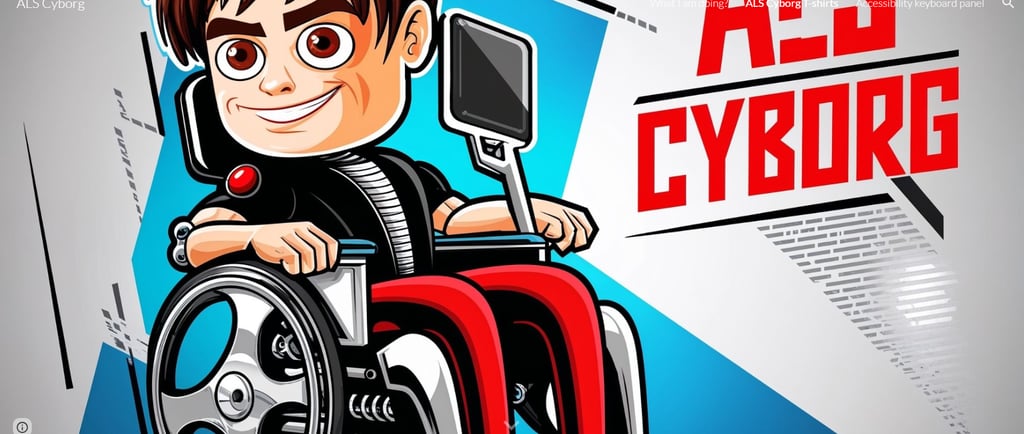
Source: https://www.alscyborg.com/
Introducing a Visionary Thinker in Technology and Mobility
While developing new content for Loop Nashville, the editorial staff encountered a remarkable individual whose work merits far wider recognition. Brand Smith, known on X as @ALSCyborg, offers one of the most forward-looking perspectives on technology, accessibility, and transportation available today. Living with amyotrophic lateral sclerosis (ALS), Smith faces limitations that would silence many. Yet through perseverance and groundbreaking medical innovation, he has become a striking example of human resilience and technological possibility.
Smith was the third person in the world to receive a Neuralink brain–computer interface implant. This device interprets signals from his brain and converts them into digital commands, allowing him to communicate and interact with technology through thought alone. For someone navigating the physical challenges of ALS, the impact is profound. It restored meaningful independence, enabling him to write, participate in discussions, create content, and share his ideas with a global audience.
He now uses this restored communication ability to talk not only about his condition, but also about autonomous vehicles, The Boring Company’s Loop system, and the future of mobility. Through his website and YouTube channel, he is demonstrating what can happen when cutting-edge engineering and human determination converge, making him a powerful voice in conversations about innovation and accessibility.
A Unique and Forward-Looking Perspective on Autonomous Transit
Smith’s commentary is especially valuable because he understands intimately what transformative technology can accomplish. His experience positions him to evaluate emerging systems not from theory but from lived impact. While some claim Loop transit and autonomous vehicles are untested or unfamiliar, Smith sees them through the lens of someone whose life has already been reshaped by bold engineering.
He should be more widely known for this perspective. His analyses consistently highlight why today’s cities must look beyond legacy systems and toward mobility solutions designed for modern needs. Through his videos, he explains why autonomy represents not only a technological shift but also a cultural one—one that prioritizes accessibility, efficiency, and flexibility over the rigid constraints of older transportation models.
Insights from Smith’s Commentary
Smith’s videos contain some of the clearest explanations of why traditional rail-based transit is increasingly mismatched to the needs of growing cities. He argues that trains, while historically significant, are structurally inflexible, expensive, and fundamentally incapable of adapting to real-time demand. Because they follow fixed routes and fixed schedules, they cannot respond to the dynamic ebb and flow of daily urban travel. In one video, he describes trains as “dumb” systems, not because they lack technical sophistication, but because they cannot think or adjust. They move where the tracks go, regardless of changing patterns or individual needs.
Smith contrasts this directly with The Boring Company’s Loop concept. He emphasizes that Loop tunnels paired with autonomous electric vehicles offer on-demand, point-to-point travel without intermediate stops. He rightly notes that this model makes transportation more personalized and dramatically more efficient. Rather than waiting on platforms or transferring between lines, passengers could travel directly to their destinations with minimal friction. He stresses that this approach also reduces cost, construction time, emissions, and congestion.
His commentary on autonomous vehicles is especially compelling. He explains that autonomy will fundamentally reshape the relationship between cities and transportation. With vehicles capable of self-navigation, the entire system becomes safer, cleaner, and more accessible. For residents with disabilities, he believes the impact will be life-changing, offering independence without the barriers associated with traditional transit or specialized transportation services. In his view, AVs will redefine not only how people move but how they live, work, and participate in their communities.
Smith also responds to skepticism surrounding new technologies. He observes that many criticisms stem from unfamiliarity rather than evidence. Just as some doubted the viability of Neuralink before seeing its results, critics of Loop transit often overlook its engineering strengths and scalability. Through his own experience, he shows that innovation should be measured by outcomes—not by initial discomfort with new ideas.
Why His Perspective Matters for Nashville
Smith’s story offers a powerful illustration of what the vision behind companies led by Elon Musk can achieve. Neuralink restored abilities he thought were gone forever, proving that bold technological ambition can produce life-changing results. He stands as living evidence of what can happen when engineers pursue solutions that once seemed out of reach. In many ways, Smith is a proof of concept: a demonstration that transformative ideas, when executed well, can dramatically improve human life.
His journey also provides a thoughtful counterweight to those who claim that Musk promises big but underdelivers. Smith’s experience is a clear reminder that such criticism is not borne out by the facts. In his own life, innovation delivered precisely what it promised—restoring independence, amplifying his voice, and unlocking opportunities that ALS had threatened to take away.
As Nashville considers the Music City Loop and explores how autonomous mobility can make transportation more efficient, equitable, and future-focused, Smith’s insights are invaluable. He shows what is possible when technology is designed for everyone, not just those who already have access or physical ability. His perspective underscores the broader promise of Loop transit: a transportation system that expands opportunity, reduces barriers, and positions Nashville at the forefront of innovation.
In a city growing as rapidly as Nashville, Smith’s story is a reminder of what the future can look like when technology and humanity work together. His voice deserves to be heard—not just because of his extraordinary personal journey, but because of what his vision means for the road ahead.
Disclaimer
LOOP Nashville aggregates publicly available news, commentary, and editorial content related to the Music City LOOP project. All source material is fully credited and attributed to its original publishers. All commentary and editorial opinions are solely those of the LOOP Nashville Editorial Staff. We are an independent site and are not affiliated with The Boring Company or the Music City LOOP project.
CONTACT
Follow
scoop@loopnashville.com
© 2025. All rights reserved.