
Business Partnerships Could Bring Music City Loop Stations to the Murfreesboro Pike Corridor
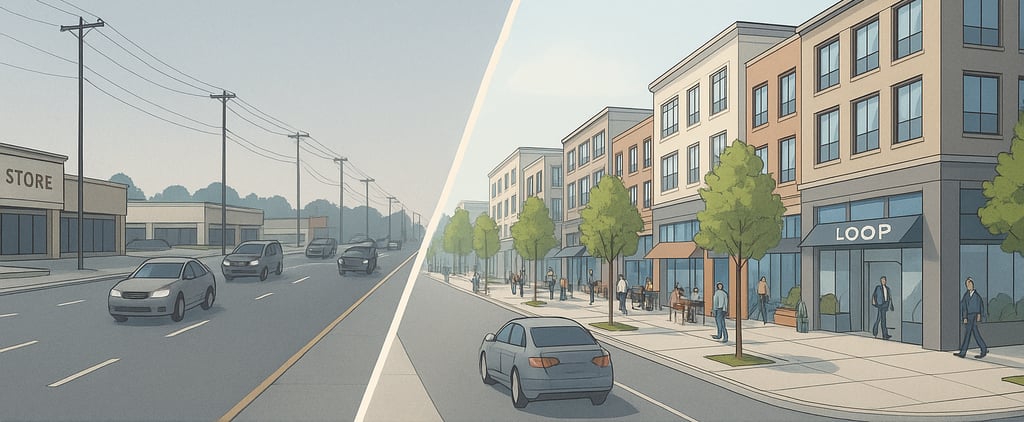
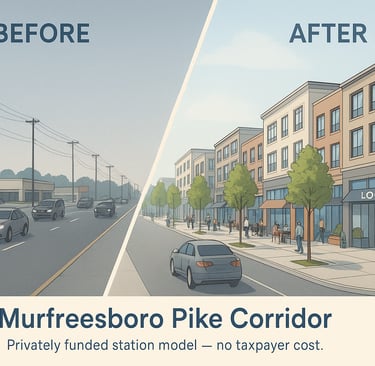
New analysis suggests businesses along Murfreesboro Pike could pool resources to bring Music City Loop stations directly to their developments. Shared transit access, paired with upzoning and mixed-use growth, could transform the corridor between downtown and the airport. [Read more ➝]
By the LOOP Nashville Editorial Staff
10/25/20253 min read
Source: Original reporting and analysis by LOOP Nashville Editorial Staff
The proposed Music City Loop is prompting new conversations about how Nashville’s business community might participate in station development along key corridors. One of the most closely watched areas is Murfreesboro Pike, a major gateway connecting downtown Nashville to the airport. With high traffic counts, large commercial parcels, and growing market pressure for redevelopment, the corridor is being viewed as a strong candidate for strategic private-sector partnerships that could accelerate transit-oriented development.
A Corridor Ready for Redevelopment
An in-depth review by LOOP Nashville’s Editorial Staff found that large portions of Murfreesboro Pike between downtown and the airport are already zoned commercial or industrial. This means the area is well-positioned for redevelopment even before major land-use changes occur. A targeted upzoning by the Metro Council—similar to recent action along Dickerson Pike—could open the door to multi-story mixed-use buildings with retail at street level and residential or office space above.
City planners have long pointed to Murfreesboro Pike as one of Nashville’s most under-leveraged corridors. With large lots, frequent vacancies, and untapped density potential, the area is considered “ripe for redevelopment.” A Loop station network could serve as a catalyst, allowing the corridor to mature into a connected district rather than a series of disconnected standalone sites.
Cooperative Loop Stations: A Shared Investment Model
Because the proposed Loop alignment would run beneath Murfreesboro Pike, nearby businesses could form voluntary “Loop cooperatives” to jointly fund a station. Instead of any one developer paying the entire cost, multiple property owners at or near a major intersection could share the expense in exchange for direct access to the system.
Benefits of this model include:
Lower Costs Per Property Owner through cooperative funding
Walkable Access from multiple storefronts and residential buildings to a single Loop station
Higher Property Values due to seamless access to downtown, entertainment districts, and the airport
Flexible Station Design Options, including surface-level entrances or direct integration into basements, lobbies, or parking structures
Because The Boring Company would not need to build extensive connector tunnels for each station, the company could efficiently link cooperative stations into the main Loop network.
Policy Recommendation: “Loop Cooperative Zones” to Transform the Corridor
A simple and targeted land-use policy by the Metro Council could unlock the corridor’s potential at no cost to taxpayers. By creating Loop Cooperative Zones at key intersections along Murfreesboro Pike, Nashville could incentivize private station partnerships and spur mixed-use construction directly tied to transit access.
Key elements could include:
Automatic Height and Density Bonuses for properties that join a Loop cooperative and integrate a station entrance
Streamlined and Fast-Tracked Permitting for mixed-use buildings connected to the Loop
Eliminating or Reducing Parking Minimums near Loop stations, lowering construction costs and making transit the preferred option
Voluntary Participation Only, with no mandates or new taxes
A Tax Windfall for Metro.
Higher-density development brings a vastly larger tax base. Multi-story mixed-use buildings generate more property tax revenue per acre than single-story strip malls or vacant lots. By placing that growth along Murfreesboro Pike—where infrastructure already exists—Metro could benefit from tens of millions of dollars in long-term taxable value without raising tax rates or expanding into residential neighborhoods.
Impact on Daily Life.
This policy approach could reshape how Nashville residents live, work, and play. By concentrating growth on a commercial transit corridor, Nashville could:
Increase housing supply, helping lower the cost of living
Protect single-family neighborhoods, avoiding forced density in residential areas
Reduce surface-level traffic by giving people a viable car-free option
Create walkable districts with shops, homes, and services just steps from transit
Revitalize an aging corridor with new investment and higher-quality development
If the Council Blocks Progress.
Should Metro Nashville continue opposing or obstructing the Music City Loop or related development, the State of Tennessee may need to consider policies that encourage private investment along transit corridors over the city’s objection. With the airport, major employers, and statewide economic interests at stake, state lawmakers could view this corridor as too important to be held back by local politics.
Challenges and Next Considerations
Questions remain regarding future station locations, system capacity, and development timelines. However, the opportunity is clear: Murfreesboro Pike has the right zoning foundation, the right location, and the right growth pressure to become a proving ground for cooperative, transit-oriented development in Tennessee.
If stakeholders engage early—before redevelopment occurs parcel-by-parcel—the corridor could become a model for how private partnerships can extend Loop access and support smart growth.
Disclaimer
LOOP Nashville aggregates publicly available news, commentary, and editorial content related to the Music City LOOP project. All source material is fully credited and attributed to its original publishers. All commentary and editorial opinions are solely those of the LOOP Nashville Editorial Staff. We are an independent site and are not affiliated with The Boring Company or the Music City LOOP project.
CONTACT
Follow
scoop@loopnashville.com
© 2025. All rights reserved.