What the poll found
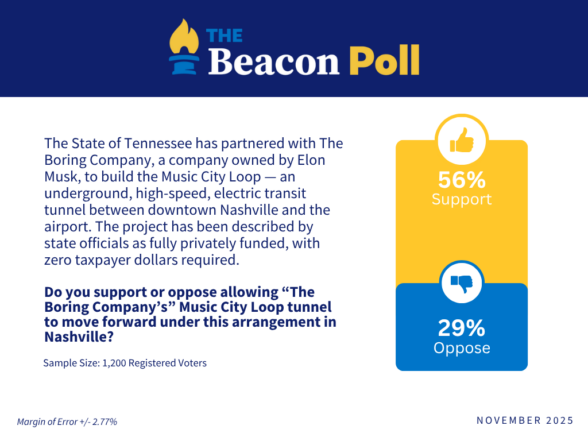
A Beacon Center survey found that 56% of registered Tennessee voters supported allowing The Boring Company’s Music City Loop to move forward under the arrangement described in the survey. Twenty-nine percent opposed it, while 15% said they were unsure.
The total included 29% who strongly supported the arrangement and 27% who somewhat supported it. Opposition included 15% who somewhat opposed it and 13% who strongly opposed it; displayed totals can differ by one point because of rounding.
How the question was framed
The question described the Music City Loop as an underground, high-speed electric transit tunnel between downtown Nashville and the airport. It also told respondents that state officials had described the project as fully privately funded with no taxpayer dollars required, then asked whether they supported or opposed allowing it to move forward under that arrangement.
That wording matters. The response reflects support for the project as presented—including the private-funding description—not necessarily views on future routes, fares, permits or operating details.
Survey details
Targoz Market Research conducted the poll from Oct. 26 through Oct. 29, 2025, among 1,200 registered Tennessee voters. The published report lists a margin of error of plus or minus 2.77 percentage points.
The crosstabs show variation across demographic groups, but smaller subgroups carry greater uncertainty than the statewide total. The poll report also marks statistically significant differences within its demographic tables.
How to read the result
The reported margin of error applies to the full sample under the pollster’s assumptions. It does not account for every possible source of error, such as nonresponse, weighting choices or the effect of the question’s description. A single survey is therefore a snapshot of opinion under one set of conditions, not a referendum or a forecast of final public acceptance.
The geographic scope is also important. The sample represents registered voters statewide, while construction and most direct operating effects are concentrated in Davidson County and at the airport. Statewide views can matter for a state-led project, but they do not substitute for measuring the experience and preferences of residents, workers, businesses and travelers along the route.
Questions the poll did not answer
Respondents were not asked to choose among alternative routes, fares, station locations or public transportation investments. The question also did not test whether support would change if construction affected a neighborhood, if operating terms changed or if public agencies incurred indirect costs. Those are separate policy questions that require separate evidence.
Future polling would be more informative if it repeated the same wording to show change over time and added questions about intended use, acceptable fares, station access, disability access and confidence in safety oversight. Publishing the full questionnaire, field dates, sample design and weighting methodology allows readers to judge whether comparisons are valid.
Public support and project approval are different
Even broad support does not grant permits or establish that engineering, environmental and safety requirements have been met. Conversely, an approved project can still face public skepticism. The poll is best treated as one input in the public discussion, alongside formal records, public meetings, construction performance and eventual operating data.
Limits of demographic comparisons
Crosstabs can reveal patterns, but every split reduces the number of respondents in a category. A difference between two subgroups may reflect sampling variation unless the report provides an appropriate statistical test. Readers should avoid turning a small percentage gap into a broad claim about how an entire community views the project.
The published statewide percentages are the clearest result. More detailed conclusions are strongest when the sample sizes, weighting and confidence intervals for the specific groups are available.
SOURCES
- Beacon Poll of Tennessee Registered Voters — demographic crosstabs · Beacon Center of Tennessee / Targoz Market Research