

The Music City Loop now has something no other American tunnel network has had
When Tennessee lawmakers approved Public Chapter 854 this spring, most of the attention surrounding the Music City Loop was understandably focused underground: tunnel boring machines, autonomous vehicles, downtown stations and the possibility of moving passengers between major destinations without adding more traffic to surface streets.
But Public Chapter 854 may ultimately be almost as important to the Loop’s long-term expansion as the tunneling technology itself. The law, sponsored in the Senate by Senate Majority Leader Jack Johnson and enacted as the Subterranean Transportation Infrastructure Coordination Act, creates an entirely new regulatory framework for privately operated underground transportation systems.
The General Assembly expressly found that conventional transportation expansion is becoming increasingly difficult because of development, right-of-way limitations, topography and urban density. It also found that underground infrastructure can add transportation capacity while minimizing surface disruption, preserving existing land uses and reducing the need to acquire new surface rights-of-way.
The Legislature identified another problem that is less visible but just as important: regulatory fragmentation. The act says large underground projects depend on predictable approval timelines and uniform standards, and warns that a patchwork of state and local permitting requirements could materially impede the private investment needed to build them.
That is the problem Public Chapter 854 attempts to solve. It does not eliminate safety regulation or give The Boring Company a blanket exemption from government oversight. Instead, it answers questions Tennessee law had never really needed to answer before: Who regulates a transportation tunnel beneath a city street? Who issues its permits? What happens when construction encounters a municipal utility? How long can a local government take to review an application? Who decides a dispute over tunneling beneath public property? And what happens if a local decision threatens to stop an otherwise state-approved expansion?
For most purposes, the act took effect July 1, 2026. Provisions allowing appointments, rulemaking, hiring and other organizational work took effect when the bill became law in April. The framework is statewide, but its immediate significance is obvious: the Music City Loop is the type of electric, emerging-technology subterranean transportation system the statute was written to govern.

First, what exactly does the new law regulate?
The statute is deliberately narrower than an ordinary transit law. A qualifying ‘transit project’ is a subterranean tunnel or system of tunnels designed primarily for intrastate transportation of passengers or goods for non-highway use using electric, autonomous, low-emission or other emerging vehicle technology. The tunnels must be built deep enough to avoid interference with surface uses.
The definition specifically excludes conventional public mass-transit projects occupying state highway rights-of-way, including rail transit and fixed guideways. In other words, the Legislature did not rewrite Tennessee transportation law generally. It created a new statutory category for an emerging kind of infrastructure that did not fit comfortably inside laws written for roads, railroads, utilities and ordinary buildings.
There are actually two new entities, and they do very different jobs
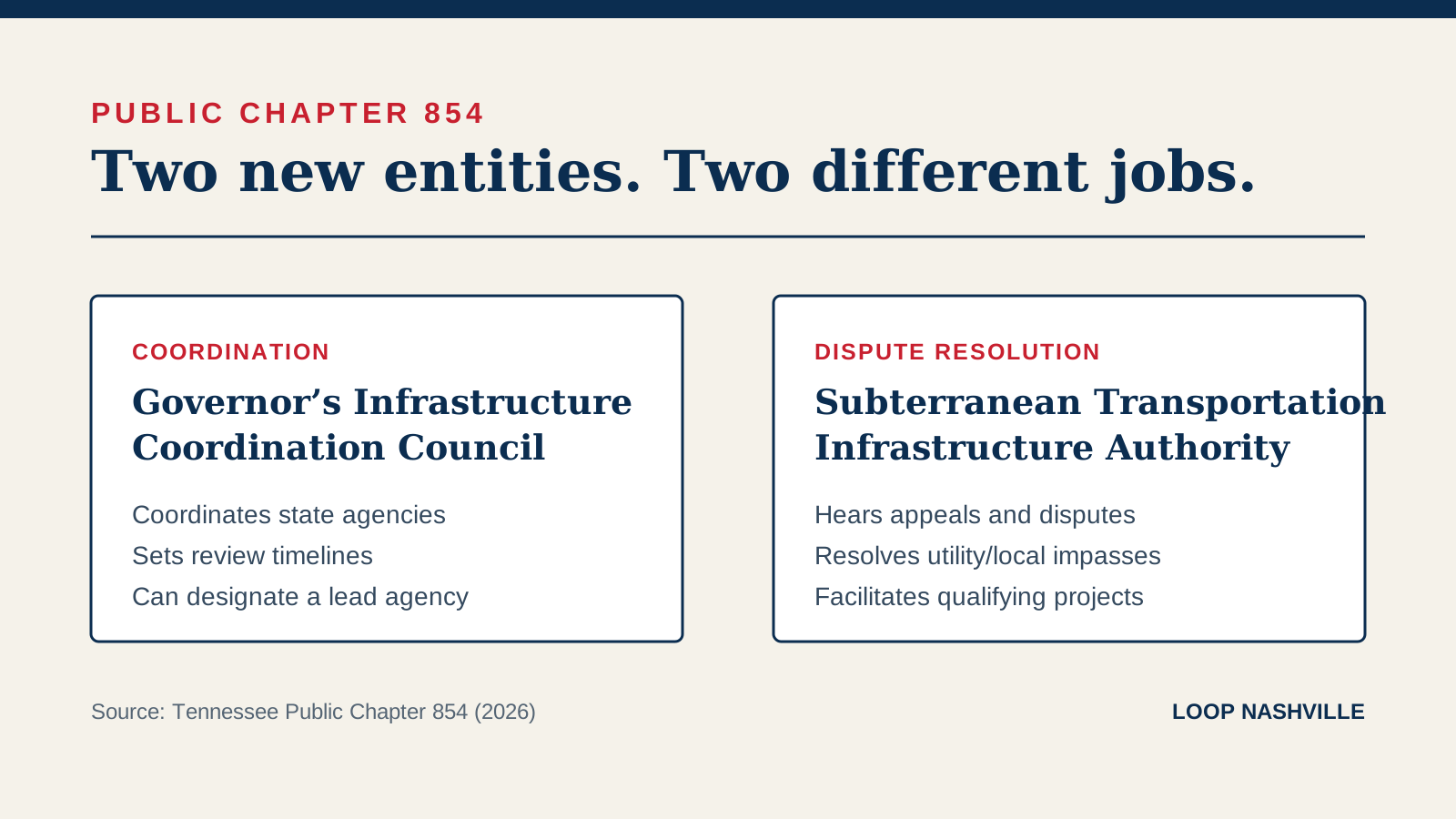
One of the easiest things to misunderstand about Public Chapter 854 is that it did not simply create a single ‘tunnel board.’ It established two separate institutions: the Governor’s Infrastructure Coordination Council and the Subterranean Transportation Infrastructure Coordination Authority.
The Governor’s Infrastructure Coordination Council
The first entity is an executive-branch coordinating body made up of the commissioners of Transportation, Commerce and Insurance, Environment and Conservation, Economic and Community Development, Finance and Administration and General Services, plus any other executive official the governor determines should participate. The governor appoints a State Infrastructure Coordinator to chair the council.
Think of the council as the state government’s coordinating table. Instead of an operator separately navigating multiple agencies with unrelated schedules, the council can coordinate reviews, establish timelines, designate a lead agency and create a consolidated application process. Individual departments do not lose their underlying statutory authority. An agency that has legal authority over a particular permit still makes that decision. The difference is that the reviews can be coordinated rather than proceeding through disconnected bureaucratic tracks.
The Governor’s Infrastructure Coordination Council held its first official meeting on July 30, beginning the work of turning the statute’s coordination provisions into an operating process.
The Subterranean Transportation Infrastructure Coordination Authority
The second institution becomes especially important when something goes wrong. The Subterranean Transportation Infrastructure Coordination Authority was legally created July 1 as an instrumentality of the State of Tennessee. Its statutory mission is to resolve disputes, hear appeals and exercise the powers needed to facilitate construction, operation and maintenance of qualifying transit projects.
That makes the Authority the referee when an operator, utility or local government reaches an impasse. Its job is not to design the Loop or replace every agency that already regulates infrastructure. Its job is to make sure disputes do not become indefinite regulatory roadblocks.
Who sits on the new board?
The Legislature intentionally did not design the Authority as a conventional political board composed only of elected officials or agency heads. There are nine voting members, divided evenly among three appointing authorities, with expertise requirements written directly into state law.
The governor appoints three members with expertise in utilities infrastructure, transmission and regulation; transportation and civil engineering; and economic development and tourism.
The Speaker of the House appoints three members with expertise in geotechnical and structural engineering; financial transactions and public finance; and public policy and government relations.
The Speaker of the Senate appoints three members with expertise in public transportation and urban planning; local-government permitting and land-use regulation; and environmental science, sustainability and safety.
Three additional officials serve as nonvoting, ex officio members: the State Infrastructure Coordinator, the Commissioner of Commerce and Insurance and the Commissioner of Transportation. Initial voting members receive staggered two-, three- and four-year terms; later appointments are for four years. Five voting members constitute a quorum, meetings are subject to Tennessee’s Open Meetings Act, and members must disclose conflicts of interest.
The Authority convened its inaugural meeting in September and began the basic work of organizing the new body. That means the framework is no longer merely a set of provisions in the Tennessee Code. Its governing institutions are beginning to operate.
The biggest change: Tennessee now owns the regulatory lane underground
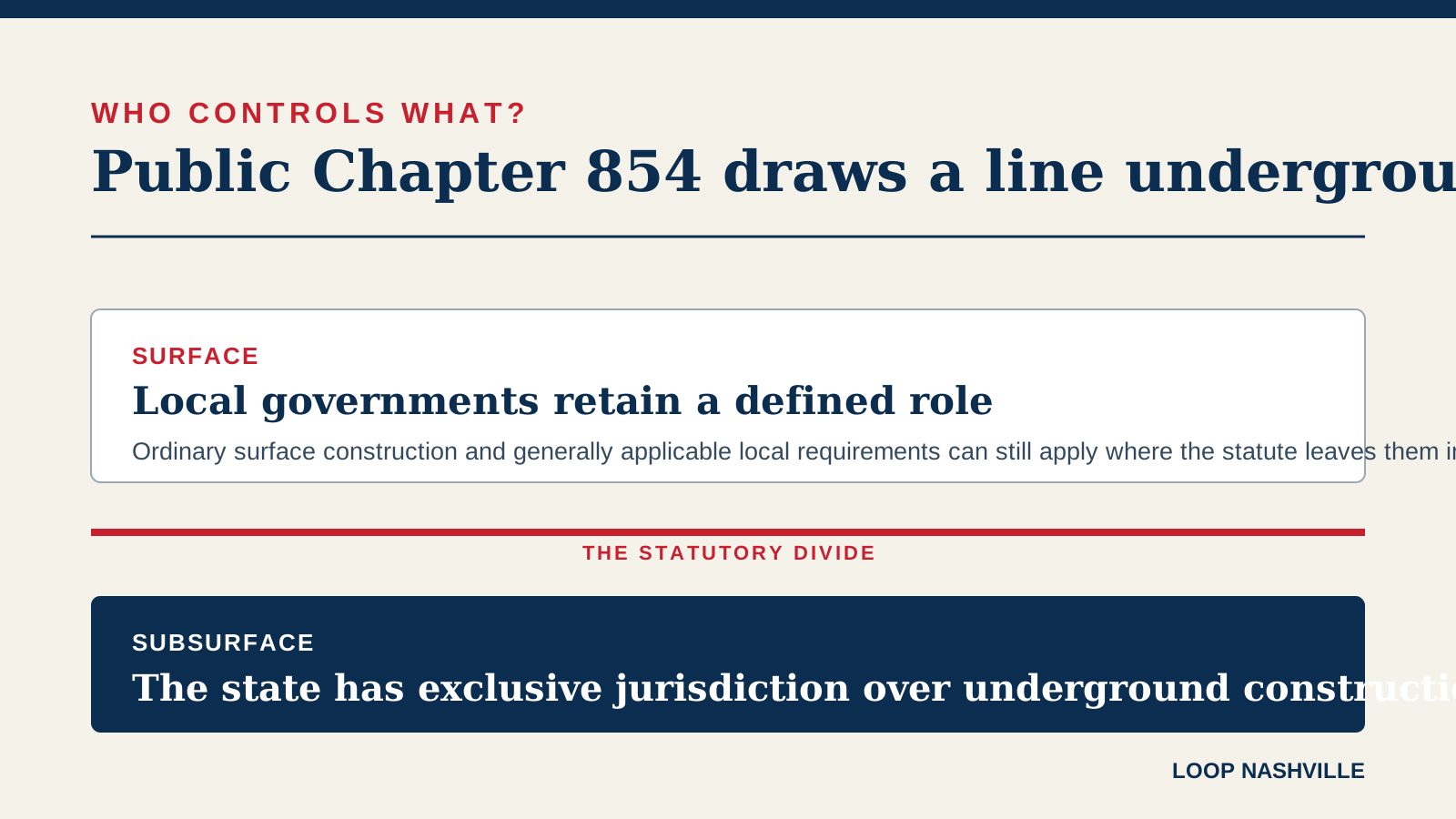
The most consequential sentence in the entire act may also be one of the shortest: ‘The state has exclusive jurisdiction over subsurface construction.’
Under the new law, local governments cannot create their own permitting systems, inspection requirements or construction standards for the underground portions of a qualifying project. Permitting, inspection and enforcement authority for subsurface construction is vested in the State Fire Marshal.
The State Fire Marshal is directed to operate a streamlined state-level process covering design, construction, operation and maintenance. The standards can encompass building, engineering, construction, fire safety, ventilation, inspection and permitting. A state permit for subsurface construction preempts duplicative local underground permits and inspections.
That does two things at once. It creates one consistent safety regime for the underground portions of a qualifying network regardless of which city or county lies above a tunnel, and it removes the possibility that the same underground system must satisfy a different local subterranean permitting regime every time it crosses a jurisdictional line. For a 25-mile network intended to grow through many stations and branches, that could be transformational.
Local governments still have a role, but there are now clear boundaries
Public Chapter 854 does not remove local government from the process. Local governments retain authority over ordinary surface construction within their jurisdiction and may continue applying generally applicable building and safety standards where the statute leaves those matters under local control.
But the Legislature drew an unusually sharp line between surface and underground jurisdiction. Stations, entrances, exits, portals, ventilation infrastructure, electrical systems, emergency access structures and related facilities formally described as part of the transit project are treated differently from ordinary surface development. Local governments also may not regulate the underground tunnel itself, its design or operation, or the location of designated project entrances, exits, stations and portals in ways the act prohibits.
The law also bars a local government from adopting zoning, land-use, construction or safety requirements that prohibit or effectively prohibit a qualifying transit project, and it prevents a surface approval from being used indirectly to regulate the underground system. That does not mean every development decision around a station is immune from local law. It means the project cannot be defeated through a regulatory back door when the statute assigns the underlying matter elsewhere.
The Legislature also put a clock on local review
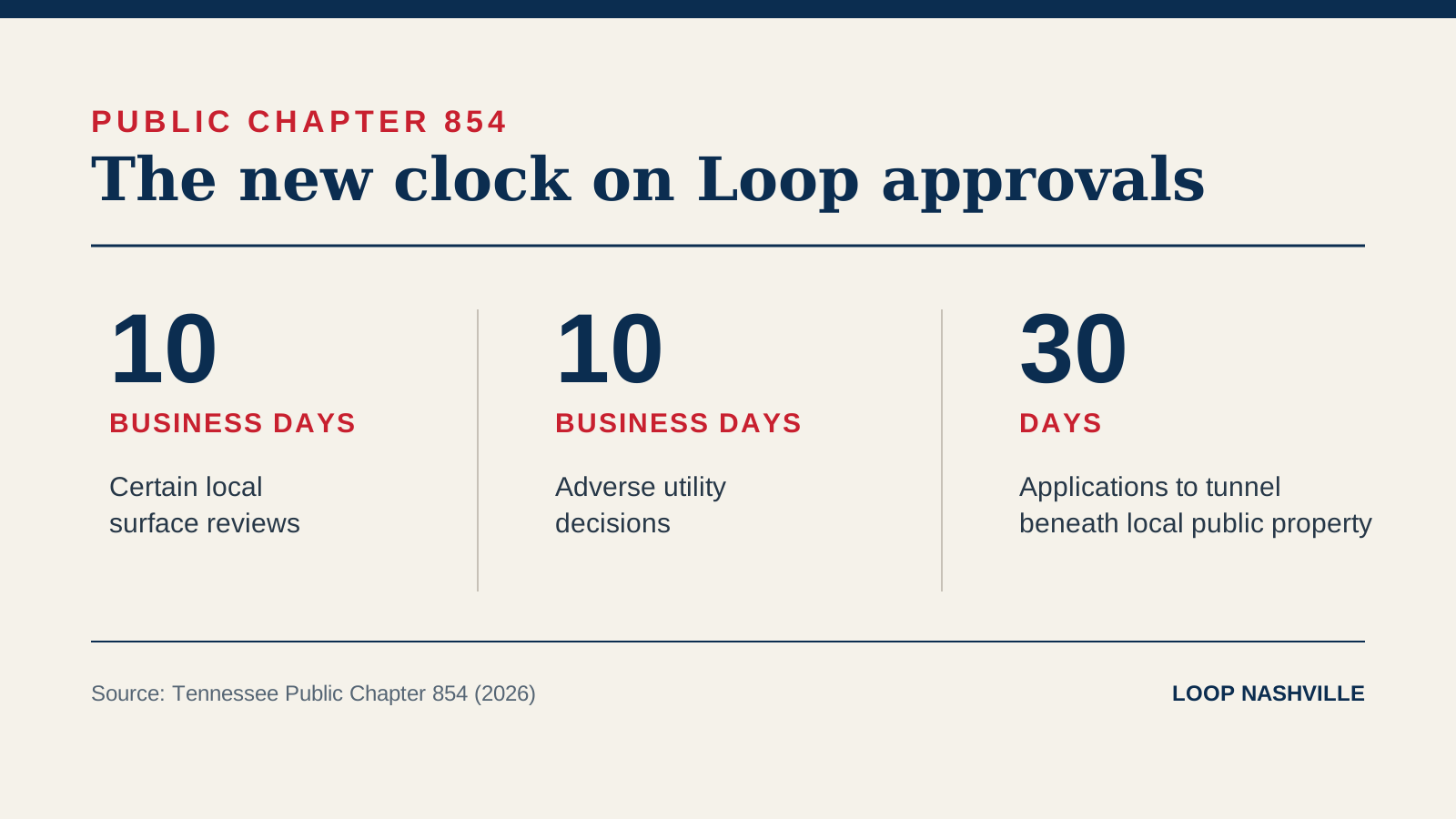
Even where local approval is required, indefinite review is no longer an option. For covered surface-construction submissions, a local government has 10 business days to approve the submission, identify specific deficiencies or request reasonably necessary additional information.
The law contains an important anti-delay provision: the local government must identify all known deficiencies during its review. After the operator corrects them, the government receives another 10-business-day review period and generally cannot begin issuing new objections that reasonably could have been identified earlier. If the local government simply does nothing, the failure to act is treated as a denial that can be appealed to the Authority.
Utilities get their own fast-track process
For an underground network, permitting is only half the challenge. Below a major city is another infrastructure network: water lines, sewers, stormwater systems, electric infrastructure, communications lines, fiber and other utilities. Public Chapter 854 devotes an entire part of the law to those conflicts.
Utilities still receive applications through their normal processes, and the tunnel operator remains responsible for the actual cost of relocating, protecting, adjusting or reconstructing utility infrastructure when the project requires it. But ‘actual costs’ are carefully defined. They generally do not include unrelated upgrades, capacity betterments beyond what existed before, unsupported above-market expenses or costs that could reasonably have been avoided through commercially reasonable methods.
If a utility denies service, refuses a necessary relocation, blocks construction around one of its property interests or demands costs beyond the statutory definition, it must issue a written adverse decision within 10 business days. That decision can be appealed to the Authority. Each new branch and station creates new opportunities to encounter existing utility infrastructure, so converting those disputes from open-ended negotiations into a defined process with a written record, deadline and appellate forum could be one of the law’s most important contributions to expansion.
What happens when the Loop needs to pass beneath city-owned property?
This portion of the act could matter enormously as the network moves beyond state-owned rights-of-way. If an operator needs to build beneath property owned by a city or county, it may apply to the local governmental entity and provide the proposed alignment, depth, engineering information and legal description.
The local government may evaluate whether the tunneling would materially and substantially interfere with the present or reasonably foreseeable use of its property. But it has 30 days after receiving a complete application to issue a written decision. A denial must identify the specific basis for the denial and the public property interest or use that would be affected.
If the application is approved, the local government must enter into the necessary lease or agreement. If both sides agree the tunnel can be built but cannot agree on the lease term, the Authority can conduct an expedited hearing and establish that term. The local agreement also cannot impose conditions more stringent than those contained in a substantially similar Tennessee Department of Transportation agreement for a transit project on state-owned property or rights-of-way.
That creates a major new pathway for future Loop extensions. A route does not necessarily have to be abandoned simply because a short segment passes beneath a municipal street, right-of-way or other locally owned property. There is now a statutory process for reaching an agreement, identifying legitimate protections and resolving an impasse.
One notable exception is important: airport authorities created under Tennessee’s airport-authority statutes are expressly excluded from the act’s definition of a ‘local governmental entity.’ The special local-property procedures in this chapter therefore should not simply be assumed to govern an airport authority such as the Metropolitan Nashville Airport Authority.
And there is an ultimate backstop
Public Chapter 854 gives the Authority eminent-domain power, but it is narrower than that phrase may initially suggest. The Authority’s special condemnation power applies only to property interests owned by or held for the benefit of a local governmental entity. It cannot use this section to condemn ordinary private property for a Loop station.
The power also cannot interfere with a prior public use, cannot be used to acquire property interests for unrelated surface development, and is not the first step in a disagreement. The statute requires a complete application, a denial or failure to act, good-faith negotiations, a petition to the Authority, a hearing and ultimately a condemnation proceeding in court. The law also protects certain planned public uses of surface property.
The significance is not that Tennessee expects the Authority to condemn municipal property routinely. The significance is that a dispute involving local-government property no longer necessarily gives one jurisdiction an absolute veto over an otherwise lawful regional subterranean transportation corridor. That changes the negotiating landscape even if the power is rarely used.
The appeals process may be the most powerful feature of the new board
The Authority can hear appeals involving local-government denials or conditions, missed statutory deadlines, adverse utility decisions and disputes over infrastructure coordination or lease terms. What makes that power especially significant is how the appeal is decided.
The review is de novo. The Authority does not simply ask whether the city or utility acted reasonably based on its earlier record. It can examine the matter again, consider additional evidence and reach its own decision. The statute expressly says the Authority does not defer to the local government or utility’s legal conclusion, policy determination or discretionary judgment.
The local government or utility also bears the burden of defending the challenged action. To sustain a denial, condition, restriction or adverse decision, it must prove by a preponderance of the evidence that the action is authorized by law, based on objective and specifically identified facts, reasonably necessary to prevent material interference with public property or the safe and reliable operation of utility infrastructure, and narrowly tailored so it does not prohibit or materially delay the project more than necessary.
If that showing is not made, the Authority must invalidate or modify the challenged action as needed to permit continued construction, operation or maintenance while still protecting legitimate public or utility interests. In practical terms, the question changes from ‘Can the operator convince every individual government or utility to reverse itself?’ to ‘Can the government or utility demonstrate to a statewide expert board that the restriction is actually necessary?’
Why this matters much more for a 40-station Loop than for a two-station airport tunnel
The first version of the Music City Loop announced in 2025 was easy to understand as an airport-to-downtown connection. That is no longer the scale of the network being contemplated. The Boring Company said in August that its executed TDOT tunnel permit and lease agreement covers approximately 25 miles of tunnel within TDOT right-of-way, and that more than 40 stations were in various stages of planning and design.
That changes the regulatory math. A single connector might encounter a manageable number of property owners, utilities and governmental approvals. A true urban network with dozens of stations will encounter far more. Every additional branch creates another chance to cross a road, encounter a utility, require a surface entrance, touch public property, need an easement or negotiate a station agreement. Without a repeatable legal framework, the complexity of approvals could grow almost as quickly as the tunnel network itself.
Public Chapter 854 is designed to prevent that. Once the rules governing the first expansions are established, the same rules can be used for later branches and stations. The project no longer has to invent an entirely new regulatory process every time the map grows.
The law is designed to make expansion faster in six different ways
One coordinated state process: agencies keep their legal authority, but the Governor’s Infrastructure Coordination Council can align timelines, designate a lead agency and create consolidated applications.
One underground safety regulator: the State Fire Marshal becomes the statewide permitting, inspection and life-safety authority for subsurface construction, avoiding duplicative local underground permitting.
Hard deadlines: 10-business-day review clocks apply to important local surface reviews and adverse utility decisions, while a 30-day clock applies to applications to tunnel beneath local-government property.
A defined escalation path: missing a deadline or receiving a denial does not strand the operator indefinitely; it creates a path to appeal.
A common evidentiary standard: local governments and utilities may protect legitimate public uses and safety interests, but restrictions must be specific, evidence-based, necessary and narrowly tailored.
A property-dispute backstop: the Authority can resolve certain lease-term disputes and, after substantial procedural protections, has limited condemnation authority over local-government property interests needed for a transit project.
Together, those provisions convert what could otherwise become dozens of unrelated negotiations into a repeatable statewide process. That is precisely the kind of legal infrastructure required if the Music City Loop is going to evolve from a single route into a network.
Faster does not mean unregulated
That distinction is important. Public Chapter 854 intentionally limits local control over underground construction and prevents local land-use rules from being used to effectively block a qualifying project. That is a significant policy choice by the General Assembly. But it would be inaccurate to describe the statute as simply deregulating tunnel construction.
It is more accurately described as regulatory consolidation. The State Fire Marshal retains plan-review, permitting, inspection and life-safety authority underground. State environmental, transportation and other agencies retain powers already assigned to them by law. Local governments retain generally applicable authority over defined surface construction. Utilities may protect existing systems when a genuine engineering or safety conflict exists.
The operator is also required to indemnify the state, local governments, utilities and private parties for damages arising from the operator’s actions, omissions or negligence. And the act creates a detailed emergency-response structure: the operator has responsibility for initial emergency response, emergency medical services, fire suppression, life safety and security inside the defined subterranean project, while the State Fire Marshal retains its regulatory role and local responders may participate through coordination, mutual aid and incident support. Written emergency-response and life-safety protocols must be provided to the Authority and relevant local emergency agencies.
The theory behind the statute is therefore not fewer safety rules. It is fewer overlapping decision-makers applying different rules to the same underground infrastructure.
Even litigation gets its own lane
The Legislature also attempted to keep the regulatory process from simply being recreated through years of fragmented litigation. Civil actions challenging specified decisions under the act generally go to a three-judge panel with exclusive jurisdiction, and the panel conducts de novo review. Negligence claims are treated separately.
That matters because certainty is one of the act’s recurring themes. A private company considering hundreds of millions or billions of dollars in infrastructure investment needs more than engineering standards. It needs to know which government makes a decision, how long that decision should take, where an appeal goes and what legal standard applies when somebody says no. Public Chapter 854 attempts to answer those questions before the disputes occur.
The law that passed is different from some early descriptions of the bill
Readers who followed the legislation while it moved through the General Assembly may remember earlier reports describing a somewhat different authority. That is because the proposal evolved substantially. Earlier fiscal documents analyzed versions with a different structure, while the final enacted law establishes nine voting members plus three nonvoting ex officio members and allows the Authority itself to employ no more than three full-time employees.
The final public chapter, rather than an earlier amendment or fiscal memorandum, is the document that controls. It gives the Authority broad legal tools but creates a relatively small organization that can use existing Commerce and Insurance resources and retain outside contractors when specialized expertise is needed.
Is Tennessee really the first state in the country to do this?
Based on LOOP Nashville’s review of comparable state frameworks, Tennessee appears to be the first state to enact a dedicated statewide regulatory and dispute-resolution framework specifically for subterranean transportation networks of this kind. That distinction should be stated carefully. Tennessee obviously did not build America’s first transportation tunnel, and Nashville is not the first city where The Boring Company has operated a Loop.
Las Vegas already has an operating underground Loop, but Nevada’s system is governed differently. The Vegas Loop has principally advanced through a Clark County franchise agreement and related state and local regulatory systems. Nevada has not created a Tennessee-style statewide tunnel infrastructure authority with the same combination of underground preemption, coordinated agency review, public-property procedures, utility appeals and specialized dispute resolution.
That is what makes Tennessee’s approach novel. Rather than waiting for underground transportation networks to become common and then trying to fit them into laws written for other infrastructure, Tennessee created a statutory category and statewide framework before the Music City Loop reaches full scale. In that sense, Tennessee is not simply approving a new transportation technology. It is building the governmental framework for an entirely new class of infrastructure.
The Authority is only now beginning its work
The statutory framework is complete, but its implementation is just beginning. The Governor’s Infrastructure Coordination Council met for the first time in July, and the new Authority convened in September. Among the next important steps are the procedures and rules that turn the statute into a working regulatory system: appeal procedures, agency coordination agreements, State Fire Marshal requirements, administrative processes and practical standards for resolving disputes as projects expand.
Those details matter because the Legislature gave the Authority substantial tools. It can establish expedited appeal procedures, coordinate deadlines among agencies, enter contracts, accept certain grants and non-state incentives, acquire and manage property, resolve utility and local-government disputes and, within the limits of the law, regulate subsurface infrastructure needed for a transit project.
How frequently the Authority actually needs to use those powers may become one measure of whether the system works. A successful framework would ideally resolve most issues before they ever become formal appeals.
The bottom line
The physical challenge of building the Music City Loop is obvious. Tunnel boring machines have to cut through Nashville rock. Stations have to be built. Vehicles, ventilation, communications, power and life-safety systems all have to work together beneath an active city. Public Chapter 854 addresses a different kind of engineering problem: government itself.
A 40-plus-station underground network cannot realistically scale if every extension begins an entirely new argument over which agency has jurisdiction, which permit applies, which utility controls the route and how long each government may take to answer. Tennessee’s answer is now written into state law: one state framework underground, one statewide safety regulator, defined roles for local government, firm review deadlines, coordinated state agencies, a specialized appeals board and a process for resolving the property and utility disputes that become increasingly likely as the map grows.
The Boring Company still has to build the tunnels. But Tennessee has now built something almost as important if the Music City Loop is going to grow into the transportation network its planners envision: a legal framework designed to expand with it. And, at least for now, no other state appears to have built one quite like it.
SOURCES
- Tennessee Public Chapter 854 (SB 2205), Subterranean Transportation Infrastructure Coordination Act · Tennessee Secretary of State
- Governor’s Infrastructure Coordination Council meeting, July 30, 2026 · State of Tennessee
- Subterranean Transportation Infrastructure Authority meeting, September 9, 2026 · Tennessee Department of Commerce and Insurance
- August 2026 Music City Loop update · The Boring Company
- Fiscal Memorandum for SB 2205 · Tennessee General Assembly
- Nevada legislative presentation on the Vegas Loop and Clark County franchise framework · Nevada Legislature