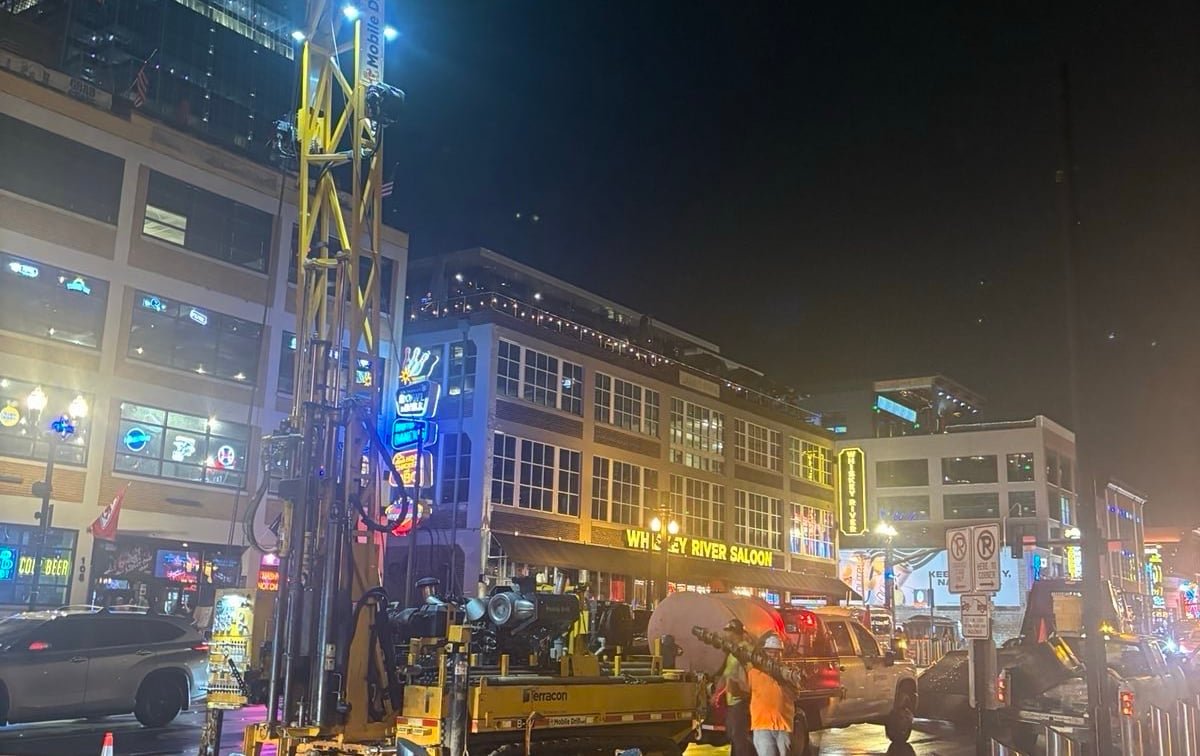
The Music City Loop could create a sizable pipeline of private construction work around Nashville stations, but the companies that will perform much of that work are still largely out of public view.
The Boring Company's current Music City Loop FAQ says more than 40 stations are in various stages of design. It adds that local contractors are "typically used for most/all of station construction," which the company says would mean more than 30 station infrastructure projects in addition to the tunnels.
That statement points to a potentially significant construction market surrounding Music City Loop.
It does not identify who will receive the work.
Tunnel construction and station construction are different businesses
The Boring Company is vertically integrated around tunneling. It designs and manufactures its Prufrock tunnel boring machines and operates the equipment being used beneath Nashville.
Stations are a different part of the build.
The company's FAQ says station design is developed with property owners and varies with capacity. Smaller stations can use four vehicle stalls and roughly 4,000 square feet, while higher-capacity facilities can be much larger.
A station can require conventional above-ground or below-ground construction work even when the tunnel itself is excavated by TBC equipment.
Depending on the site, that can involve structural work, electrical systems, concrete, site preparation, pedestrian circulation, fire and life-safety systems, communications, finishes and integration with an existing building.
The Boring Company's statement that local contractors are typically used for that work is therefore notable for Nashville's construction industry.
Several project participants are already public
A handful of outside organizations can be identified from current project materials, although they do not constitute a complete contractor roster.
Davey Resource Group prepared the December 2025 Environmental Impact Assessment for the Airport and Broadway alignments. The Boring Company says UES separately reviewed that assessment.
Nashville Electric Service coordinated with TBC to provide grid power capable of supporting two tunnel boring machines and related equipment at the Lot 16 construction site, according to the company's current FAQ.
The Tennessee Mine Rescue Association also has a public emergency-preparedness role. In a December 2025 project update, The Boring Company said the association's Tunnel Rescue Team had provided an emergency response trailer and was coordinating training and drills.
Nashville Fire Department personnel have also been involved in emergency-response discussions, but NFD is a government public-safety agency, not a project contractor.
Those relationships show the range of outside organizations touching the project. They do not answer the central business question of which private construction companies are building stations, shafts, site improvements or other physical infrastructure.
The job board shows TBC building its own local capacity
The Boring Company's own Nashville hiring also gives some clues about how the project is being organized.
Its careers page currently lists Nashville positions in field engineering, mechanical engineering, land acquisition, compliance, facilities, construction operations, procurement, safety and Music City Loop operations.
Openings include a buildout electrical supervisor, construction operations planner, inventory control specialist, supply chain specialist and operations manager for Music City Loop.
Those roles suggest TBC is building internal capacity to manage construction and vendors even as it says local contractors will be used for station work.
The company has not publicly disclosed how it will bid, select or announce local station contractors.
More stations could mean more local procurement
The scale depends on how many of the company's 40-plus station discussions become actual projects.
Several locations have advanced publicly. BNA has an approved station relationship with design and permitting underway. TBC says it has agreed to terms with the JW Marriott. Giarratana says it has a residential station agreement at PRIME. Music City Center has approved a tunnel easement and remains in station-design discussions.
Each site could have a different delivery structure because the station is being developed with a different property owner.
The company's current public materials do not say whether property owners will hire contractors directly, whether TBC will control procurement, or whether the structure will vary by station.
What remains unknown
No comprehensive Nashville vendor list, contractor directory or station procurement schedule was found in the public materials reviewed for this article.
The Boring Company's references to "strong local vendors" and local station construction are broad. They do not identify the firms, contract amounts or scopes of work.
That means it would be premature to describe the 30-plus figure as 30 awarded construction contracts. It is the company's estimate of potential station infrastructure projects based on its station pipeline.
For Nashville's construction community, the next meaningful disclosures would be contractor names, building permits, station construction values and procurement announcements tied to individual properties.
Those filings may also provide one of the best ways to track which of the 40-plus station discussions are moving from design into actual construction.
SOURCES
- Music City Loop · The Boring Company
- Careers · The Boring Company
- Music City Loop Blog — April 1, 2026 · The Boring Company
- Music City Loop Blog — December 1, 2025 · The Boring Company
- Environmental Impact Assessment · Davey Resource Group / The Boring Company