In 2018, the Southern Environmental Law Center supported a transportation plan that would have put trains and buses beneath downtown Nashville.
The Let’s Move Nashville proposal included an underground connection through the central business district, financed as part of a broader package of tax increases. SELC endorsed the plan while Metro’s planning documents acknowledged that additional information and engineering were needed to fully evaluate the tunnel’s feasibility.
Nashville’s limestone was a condition engineers would have to address as the project advanced.
Today, SELC is questioning the environmental safeguards for another transportation tunnel beneath the same city. This time, the developer is Elon Musk’s The Boring Company.
The projects have different routes, designs, and financing arrangements. But the comparison raises a reasonable question: What standards did SELC apply to the tunnel it supported, and what would satisfy its concerns about Music City Loop?
We suspect the organization’s political commitments help explain its approach. Its transportation advocacy, relationship with Metro, and broader confrontation with Musk provide ample reason to examine that possibility.
Publishing its complete analysis would give Nashville a better way to judge.
An Established Transportation Agenda
SELC has been an active participant in Nashville’s transportation debate for years.
It supported the 2018 transit proposal and later promoted Choose How You Move, the 2024 referendum that increased the sales tax to help finance expanded bus service, sidewalks, bicycle infrastructure, and other transportation improvements.
The organization’s financial disclosures also document grants supporting transit referendum signs and transportation lobbying elsewhere in the Southeast. Advancing particular transportation policies is part of its work.
Those commitments matter when evaluating its approach to the Loop.
SELC has already invested its institutional credibility in a vision for how Nashville should move people. Music City Loop offers a different model, built around privately developed tunnels and direct trips between stations.
Supporting one approach does not require opposing the other. Nashville could benefit from both. But readers should understand that SELC enters this discussion with established policy preferences and a record of campaigning to advance them.
The Relationship With Metro and Musk
SELC’s relationship with Nashville includes representing the city in federal litigation.
A March 2025 complaint challenging the Trump administration’s freeze of federal grants listed Nashville among the plaintiffs and Elon Musk among the defendants, in his official government capacity. SELC identified Nashville as a client and described approximately $14 million in affected city funding for electric-vehicle charging and the East Nashville Spokes transportation project.
That case concerned federal funding decisions. It nevertheless establishes a direct relationship among SELC, Metro, and the wider political dispute involving Musk.
SELC’s own communications connect those subjects. An article describing the organization’s expanded legal capacity to challenge the Trump administration highlighted an attorney working on pollution concerns involving Musk’s xAI data center. SELC has also criticized Musk’s role in DOGE.
Its leadership has substantial political connections. Board vice chair Laura Fjeld was a Democratic congressional nominee. Trustee Brenda Mallory chaired the White House Council on Environmental Quality under President Biden. Anne Davis, who established SELC’s Nashville office and remains a trustee, is married to former Nashville Mayor Karl Dean.
These relationships do not answer a geological question. They do explain why SELC’s priorities and presentation deserve examination alongside its technical claims.
The organization asks Nashville to question the developer’s assurances. Its own institutional interests warrant the same attention.
Put the Complete Analysis Before the Public
The most useful next step is straightforward: make the full analysis readily available.
The Boring Company has published its environmental assessment. LOOP Nashville has been able to examine that document, report on its findings, and identify the assumptions behind its conclusions. We have not located a publicly accessible copy of the complete SELC analysis described in recent coverage.
SELC should publish its findings, methodology, supporting records, author qualifications, and technical appendices together.
That would allow geologists, engineers, reporters, and residents to compare the two analyses directly. Where do they rely on the same information? Where do their assumptions differ? Does SELC identify conditions the project assessment overlooked, or reach different conclusions about conditions already discussed?
Those distinctions determine what the findings mean for construction.
The project assessment acknowledges karst and groundwater concerns, discusses selecting favorable geological formations, and anticipates further investigation as the design develops. Its conclusions also allow for revision if additional investigation reveals unfavorable conditions.
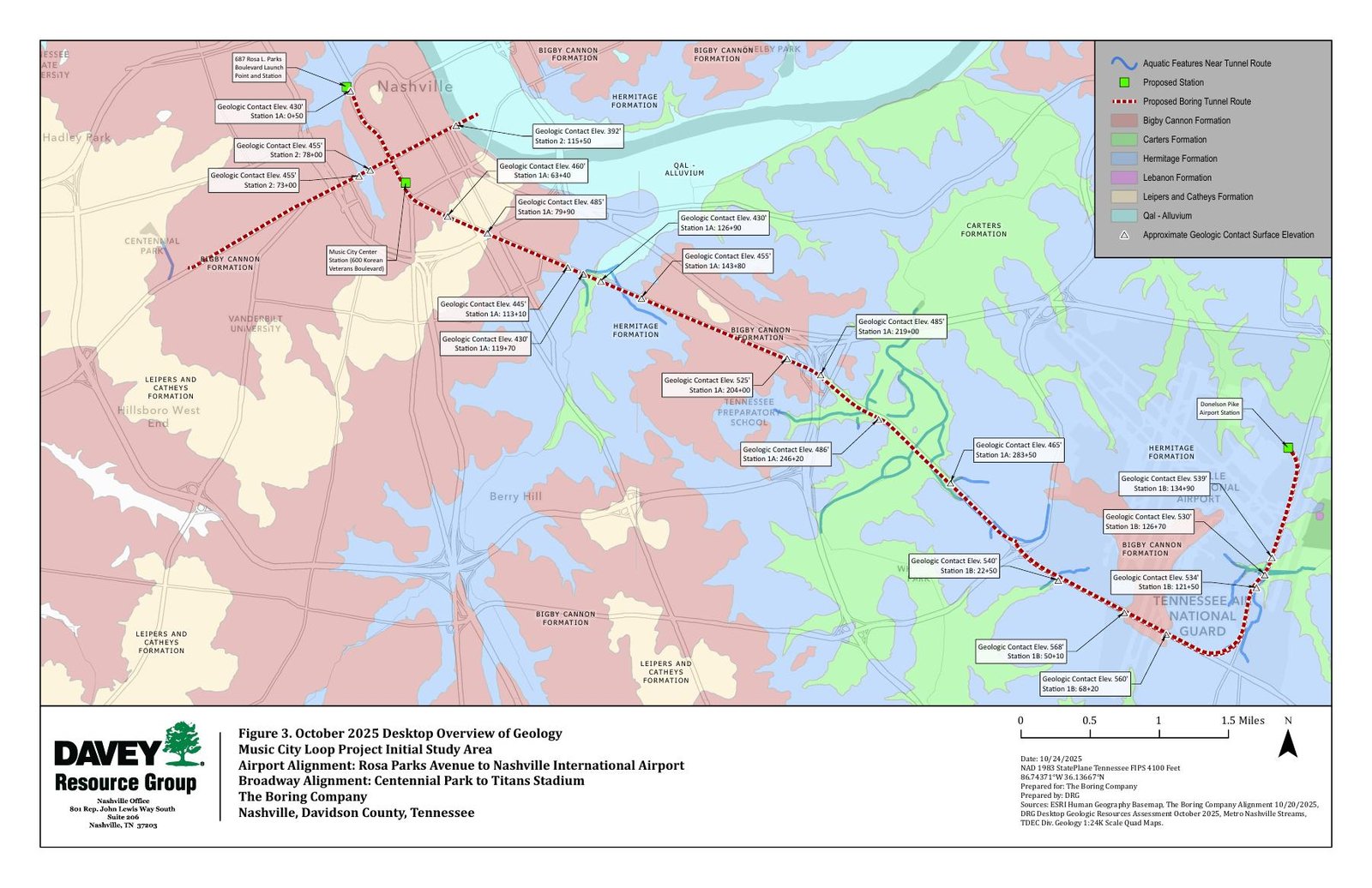
A competing analysis should explain precisely where that approach falls short.
Explain What Would Resolve the Concerns
Warnings become useful when they identify a problem and establish how it can be addressed.
If SELC believes the subsurface investigation is inadequate, it should identify the affected sections and explain what additional testing is needed.
If contaminated properties pose a threat, it should show how the proposed excavation could encounter contamination or create a pathway for it to spread.
If proposed safeguards are insufficient, it should explain which measures would protect groundwater and surface structures.
The Boring Company should provide the supporting information needed to evaluate its responses. Publishing an assessment does not settle every question about the work that follows.
The same principle applies to SELC. Public warnings should be accompanied by enough information for others to examine the reasoning behind them.
A Consistent Standard for Nashville
SELC supported pursuing a downtown tunnel in 2018 before every engineering question had been answered. Supporting a proposal at the referendum stage differs from accepting construction, and that distinction belongs in any fair comparison.
But the organization should be able to explain the standard it applied then and the standard it expects now.
Nashville needs sound engineering, effective oversight, and clear answers about construction beneath its streets. It also needs an honest accounting of the political and institutional interests influencing the debate.
We suspect those interests help shape SELC’s treatment of Music City Loop. The public should have the complete technical record to assess whether its warnings are supported by the evidence.
Publish the findings. Explain the disagreements. Identify what would resolve them.
SELC has asked The Boring Company to show its work. Nashville should expect SELC to do the same.
SOURCES
- SELC supports Nashville transit referendum
- Let’s Move Nashville transit improvement program
- Nashville has opportunity to choose how it moves
- SELC Form 990
- March 19, 2025 federal funding complaint
- SELC’s federal funding litigation and Nashville grants
- Taking on the Trump administration
- 100 days of the Trump administration
- Laura B. Fjeld biography
- Brenda Mallory biography
- Anne Davis and SELC’s Nashville office
- SELC Board of Trustees
- Music City Loop Environmental Impact Assessment
- Coverage of reported SELC analysis