
The Boring Company has made a significant safety commitment for Nashville's Music City Loop: the privately funded underground transportation network will meet or exceed NFPA 130, the national fire and life-safety standard used for fixed-guideway transit systems.
But what does that commitment mean for Nashville's tunnels? Engineering plans submitted to the State of Tennessee provide part of the answer.
A LOOP Nashville review of the project's February 2026 permit documentation and tunnel alignment drawings found extensive planning for emergency evacuation infrastructure across the airport and Broadway routes. The company's published safety commitments describe additional systems intended to detect fires, manage smoke, support emergency responders, and monitor the transportation network around the clock.
The documents also provide a basis for examining how Nashville's design compares with the safety standard the company has pledged to meet.
What NFPA 130 Actually Requires
The National Fire Protection Association develops standards used by fire departments, engineers, building officials, and transportation agencies throughout the United States.
NFPA 130, formally titled Standard for Fixed Guideway Transit and Passenger Rail Systems, establishes fire and life-safety requirements for transportation facilities. Its scope extends well beyond emergency exits.
The standard addresses station design, passenger evacuation, emergency ventilation, fire protection, communications, electrical systems, and operating procedures. These requirements are intended to work together during an emergency.
An underground fire, for example, could require the transportation operator to stop approaching vehicles, alert passengers, activate ventilation equipment, identify safe evacuation routes, and dispatch emergency responders. The systems needed to accomplish those tasks must be considered together during engineering and construction.
Although the standard has traditionally been associated with rail transportation, its underlying safety objectives are relevant to other underground passenger systems. Music City Loop's vehicle-based operation requires engineering appropriate to its own characteristics, but the fundamental objectives of protecting passengers, controlling hazardous conditions, and providing emergency access remain the same.
The Boring Company has expressly committed to meeting the standard in Nashville. In a February 19, 2026, letter supporting its Tennessee Department of Transportation permit application, the company stated that the project would be designed and constructed in accordance with NFPA 130 and applicable laws and regulations.
That commitment appears in formal project documentation, not simply promotional materials. The latest edition, NFPA 130:2026, was published in 2025. The specific edition governing Nashville's approved engineering design has not been established in the documents reviewed.
The Engineering Plans Identify Emergency Exits Throughout the Network
One of the clearest findings in the state engineering documents involves emergency evacuation.
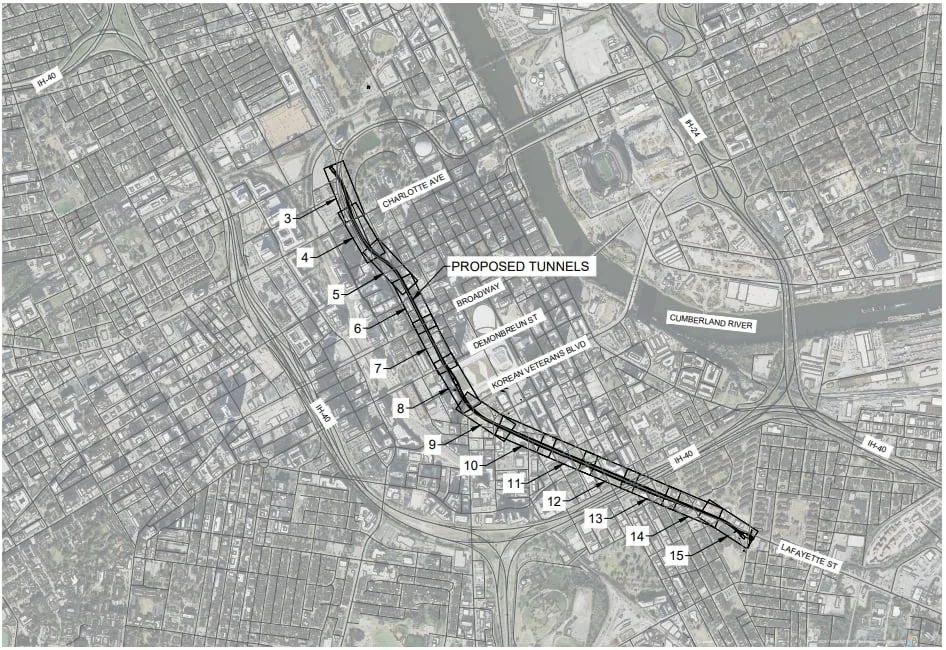
The Boring Company's February 2026 drawing packages outline two parallel, one-way tunnels along the airport and Broadway alignments. They include tunnel plans, elevation profiles, cross-sections, and separate excavation plans for proposed emergency-egress shafts.
A review of the drawing indexes identified 11 egress-shaft plan sheets along Airport Connector Phase 1A, another eight along Phase 1B, and seven along the Broadway alignment. Together, the three packages contain 26 individually identified shaft-plan sheets.
The company's February 19 permit letter, meanwhile, identifies 25 planned egress points across the project. Those figures describe different things. The drawing indexes count sheets devoted to proposed shaft locations, while the letter identifies the company's planned number of egress points. The documents reviewed do not establish whether every sheet represents a unique final exit or how separate packages and revisions will be reconciled.
The permit letter explains that the number and spacing of emergency exits may change as station agreements are finalized and risk assessments are completed. Changes to the planned number of egress points would require an amendment to the state right-of-way agreement.
That flexibility matters because emergency evacuation planning depends on more than the distance between dedicated shafts. Stations, portals, connecting passages, and other approved evacuation facilities may also provide means of leaving the underground system.
How Far Would Passengers Have to Walk?
The Boring Company's engineering drawings provide enough information to examine the spacing of proposed shaft locations along the preliminary alignments. The drawings use engineering stationing, a standard method of identifying distances along a transportation alignment.
LOOP Nashville compared successive egress-shaft locations listed in the three drawing indexes. On the Broadway alignment, the intervals between successive proposed shafts range from approximately 1,500 to 2,500 feet. The Phase 1B airport drawings show intervals generally ranging from 1,200 to 2,500 feet. The Phase 1A airport drawings include several longer intervals between dedicated shaft locations.
Those preliminary distances cannot be evaluated in isolation. A station or another qualifying exit located between two shafts could shorten the distance passengers would actually need to travel to reach safety. The final design must also account for how exits connect to evacuation routes, whether passengers can use those routes during a fire, and the requirements of the applicable code edition.
Earlier editions of NFPA 130 have included a 2,500-foot maximum distance between exits for specified enclosed-guideway configurations. The full requirements involve more than a simple measurement between shafts.
The important finding from the Nashville drawings is that emergency exits are being incorporated into the physical alignment of the transportation network, rather than left solely to future operational procedures.
Tunnel Dimensions Are Part of the Safety Design
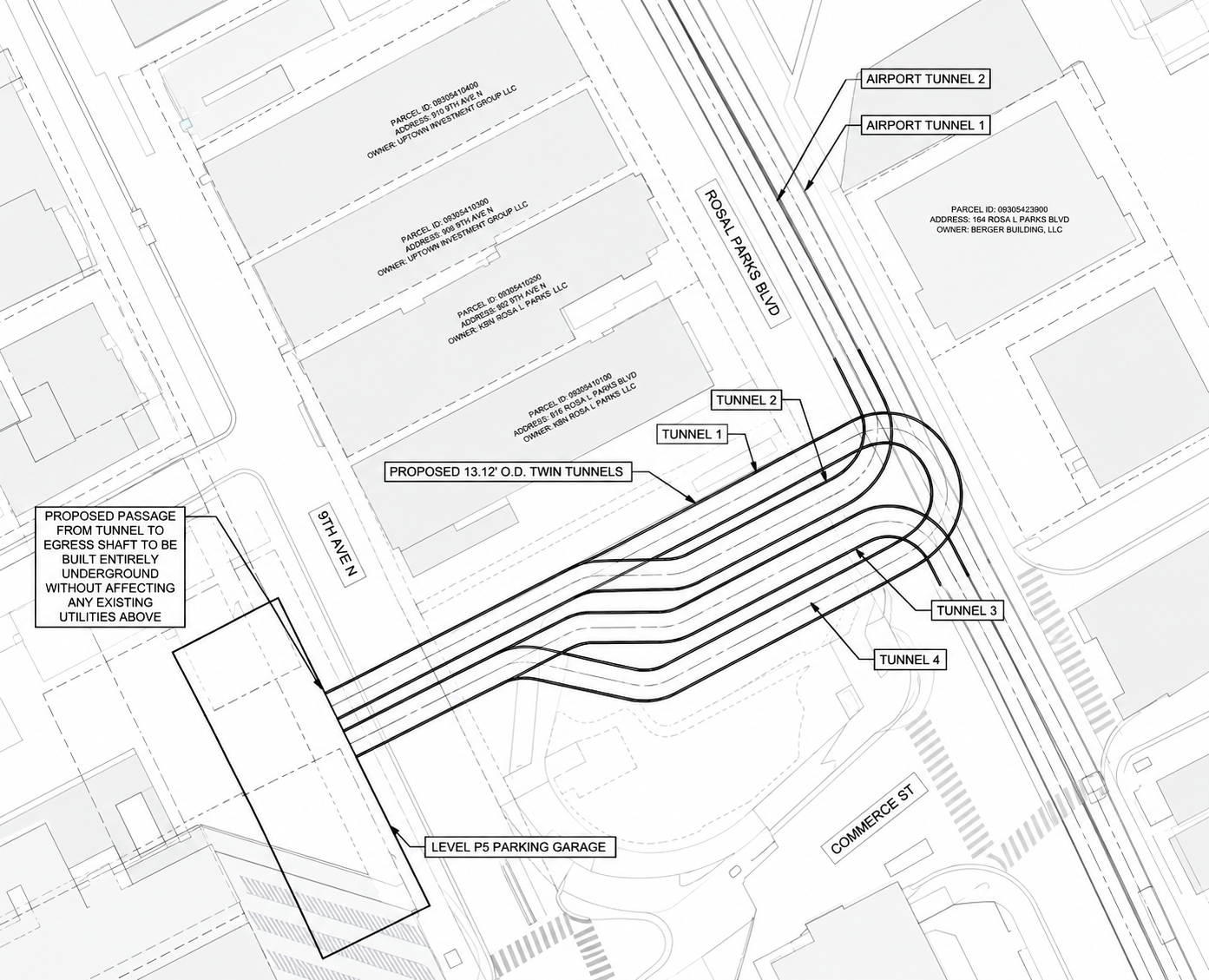
The company's state engineering plans also provide details about the physical dimensions of the proposed tunnels. The company's public project materials describe a roughly 12-foot internal tunnel diameter. Civil alignment plans depict the two proposed tunnel bores; the final usable clearance depends on the roadway, structural lining, and equipment installed inside.
Music City Loop will initially operate Tesla Model Y and Model X vehicles through dedicated one-way tunnels. Unlike traditional subways, the system does not require platforms alongside long trains throughout the underground guideway. Its roadway configuration is designed around smaller vehicles and a different passenger-loading arrangement.
The Boring Company says the tunnel's surface provides more than nine feet of unobstructed space for evacuation. Evaluating that claim against the completed design would involve the actual tunnel interior, roadway configuration, vehicle position, and equipment that could affect usable evacuation space.
A complete clearance analysis would require vehicle dimensions and the final interior configuration, not simply the nominal tunnel diameter.
Emergency Ventilation Is Designed to Manage Smoke
In an underground fire, smoke can present an immediate danger to passengers. NFPA 130 includes requirements addressing the movement of smoke and heat, particularly where those conditions could interfere with evacuation or emergency response.
The Boring Company says Music City Loop will incorporate a redundant, bidirectional ventilation system intended to move smoke and hazardous gases away from passenger evacuation routes and responding personnel. Bidirectional ventilation allows operators to control the direction of airflow based on the location and conditions of an incident.
The company also describes continuous monitoring for smoke and gases. These systems are intended to function together. Detection equipment alerts the operator to hazardous conditions, while ventilation equipment manages smoke movement as passengers and emergency personnel respond.
The company's public safety materials specifically address the possibility of an electric vehicle battery fire, explaining that ventilation would direct smoke and gases toward designated outlets. That is an important design consideration for a system using battery-electric vehicles.
A complete evaluation of the ventilation system would require engineering calculations identifying the fire scenarios used for design, airflow capacity, equipment redundancy, smoke-control performance, and backup power arrangements. Those details cannot be established from the civil tunnel alignment drawings alone.
Fire Protection Goes Beyond Smoke Control
Music City Loop's proposed fire-protection infrastructure includes wet standpipes. A standpipe system provides fixed piping and hose connections that allow firefighters to access water inside a facility without transporting an entire water supply through the tunnel.
The Boring Company also describes fire and gas detection, emergency lighting, and communications equipment intended to support emergency response. The company says tunnel lighting will include redundant systems, helping maintain visibility if normal lighting equipment becomes unavailable.
Fire detection helps identify a problem. Lighting helps passengers and responders move through the tunnel. Standpipes support firefighting operations. Communications equipment allows instructions and information to move between the tunnel and the control center.
NFPA 130 treats these systems as interconnected components of transit fire and life safety. Final equipment specifications and inspection records will be necessary to document the installed systems.
The Operations Control Center Will Monitor the Network
The Boring Company plans to operate Music City Loop through an Operations Control Center staffed 24 hours a day.
The company says vehicles will remain connected to the control center through redundant communications systems and that the tunnel network will have comprehensive camera monitoring. Additional communications provisions include emergency stations, cellular connections, secured wireless networks, and equipment intended for police and fire departments.
During an incident involving a disabled vehicle, for example, operators could monitor tunnel conditions, communicate with the driver, stop approaching vehicles, and coordinate assistance. If evacuation becomes necessary, the response could also involve ventilation controls, emergency lighting, passenger communications, and personnel dispatched to the incident.
The Boring Company says Music City Loop will initially operate with trained drivers, rather than immediately beginning driverless passenger service. NFPA 130 addresses communications and operating procedures because the effectiveness of a transit safety system depends on both equipment and the personnel responsible for using it.
Tennessee Law Makes The Boring Company Responsible for Initial Emergency Response
Tennessee's regulatory framework also places responsibility for initial emergency response directly on the operator of Music City Loop.
Under the Subterranean Transportation Infrastructure Coordination Act, enacted in 2026, the operator has exclusive authority for initial emergency medical services, fire suppression, life safety, and security operations within the designated transportation project.
That means The Boring Company will be responsible for providing the initial response to emergencies within its tunnels and stations, rather than relying on Nashville's existing emergency services as the system's primary response organization. The law does not prevent Nashville firefighters, emergency medical personnel, or other local responders from assisting.
It expressly preserves coordination and mutual-aid arrangements, allowing the operator to request additional resources when necessary. The company must also establish written emergency-response and life-safety protocols and submit them to the appropriate state and local agencies for emergency planning and coordination. Those agencies are not required to approve the protocols.
The arrangement reflects the specialized nature of underground transportation. Personnel responding to an incident must understand the tunnel layout, ventilation equipment, electrical systems, vehicle operations, and evacuation procedures.
The Boring Company has already begun assembling that capability. As LOOP Nashville previously reported, the company advertised for a Nashville-based Head of Emergency Response to oversee emergency preparedness, personnel, equipment, training, and the development of response procedures.
The company's existing Vegas Loop provides an operational example. In June 2026, The Boring Company reported that its tunnel rescue team and the Clark County Fire Department completed a joint technical rescue exercise.
The Tennessee State Fire Marshal will continue to exercise regulatory oversight of the Nashville system, including plan review, inspections, fire-code enforcement, and certificates of occupancy.
Together, these provisions establish a framework in which the operator provides the initial emergency response, local agencies remain available for coordinated assistance, and state officials oversee compliance with applicable safety requirements.
Emergency Training Will Be Part of the System's Operation
Engineering systems and emergency-response personnel must ultimately function together. The Boring Company says Music City Loop has 71 documented contingency and routine operational procedures covering incidents such as fire, flooding, medical emergencies, evacuation, and power failures.
The company reports that routine operational drills are conducted weekly, with larger exercises occurring every three months. Experience from Vegas Loop provides an existing operational foundation, although Nashville's preparations will need to account for its own tunnel network, stations, and personnel.
Safety Requirements Continue After Construction
The Boring Company's February 19 permit letter also establishes an ongoing inspection obligation for completed tunnels.
The company committed to annual structural inspections by a Tennessee-licensed professional engineer, with reports submitted to TDOT's Structures Division. It also agreed to address structural deficiencies or safety issues identified through those inspections.
Long-term operations require monitoring for structural deterioration, water intrusion, movement, and other conditions that could affect the tunnels. The commitment to recurring professional inspections provides a documented maintenance requirement beyond the initial construction process.
What the Plans Establish, and What Comes Next
The Boring Company's commitment to NFPA 130 provides an established benchmark for Music City Loop's fire and life-safety design.
The engineering documents examined by LOOP Nashville show proposed emergency-egress infrastructure throughout the airport and Broadway corridors. The company's public safety disclosures describe a broader collection of protections, including ventilation, fire detection, standpipes, emergency lighting, communications, centralized monitoring, and emergency training.
Tennessee law adds a further layer by assigning initial emergency-response responsibility to the operator while preserving state regulatory oversight and cooperation with local emergency services.
Together, those records establish that safety planning extends across the physical infrastructure, operating systems, and personnel responsible for protecting passengers. They also illustrate the difference between submitting an engineering design and demonstrating that a completed system conforms to every applicable requirement.
Final compliance depends on the governing standards, the approved design, construction inspections, and testing of installed systems. The available alignment drawings establish proposed physical infrastructure; additional mechanical, electrical, fire-protection, and operational documentation will determine how the complete system performs under emergency conditions.
For Nashville, the significance of NFPA 130 is that The Boring Company has committed to measuring its underground transportation network against established transit fire and life-safety requirements. The engineering record shows how that commitment is beginning to take physical form.
As construction continues, the next important development will be the installation, inspection, and testing of the systems that passengers will ultimately depend upon.
SOURCES
- NFPA 130, Standard for Fixed Guideway Transit and Passenger Rail Systems · National Fire Protection Association
- Music City Loop project information and safety FAQ · The Boring Company
- Music City Loop TDOT permit-support letter, February 19, 2026 · TBC-TN, LLC
- Airport Connector Phase 1A and Phase 1B, February 17, 2026 drawing indexes · The Boring Company
- Music City Loop — Broadway, February 17, 2026 drawing index · The Boring Company
- Subterranean Transportation Infrastructure Coordination Act, Public Chapter 854 (2026) · Tennessee General Assembly
- Dedicated emergency response team for Music City Loop · LOOP Nashville
- BART Operations Control Center (public-domain hero photograph) · Bay Area Rapid Transit / Wikimedia Commons