

When the Metropolitan Nashville Airport Authority approved the proposed financial terms of its agreement with The Boring Company in February, much of the attention focused on the potential $343 million in revenue the arrangement could generate for Nashville International Airport over 50 years.
But a closer examination of the airport's financial projections reveals something equally interesting: the potential scale of Music City Loop operations at BNA.
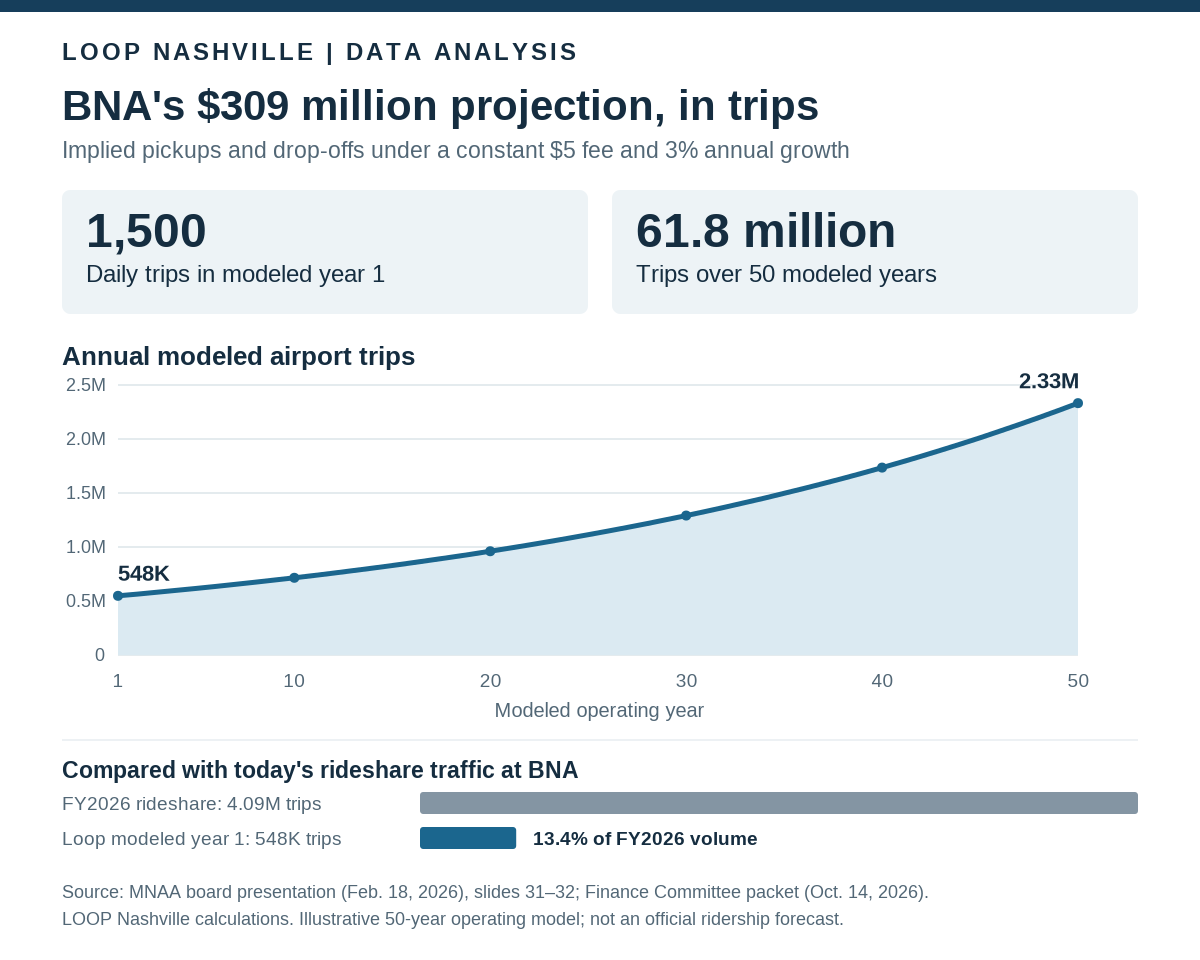
An analysis by LOOP Nashville of the figures presented to airport commissioners suggests an initial volume of approximately 548,000 annual airport pickups and drop-offs, or about 1,500 per day, under a model that assumes a constant $5 operating fee, 3% annual growth, and 50 revenue-producing years.
The figures offer an indication of the role the privately financed underground transportation system could play in Nashville's growing airport transportation market.
The numbers behind the airport agreement
The Boring Company signed its long-awaited airport agreement earlier this month, according to The Tennessean, advancing plans for a direct connection between the Music City Loop and Nashville International Airport.
Under the terms presented to airport commissioners on February 18, the airport authority projected two principal sources of revenue over a possible 50-year period:
Approximately $34 million in licensing fees.
Approximately $309 million in operating fees.
The financial projections use the airport's $5 fee for each pickup or drop-off and annual operating-fee revenue growth of 3%. Working backward from those figures over 50 annual operating periods produces approximately $2.74 million in first-year operating-fee revenue. At $5 per trip, that equates to roughly 548,000 pickups and drop-offs.
The February terms provide for a 40-year license beginning upon execution, with two optional five-year extensions. The publicly released projections do not specify an opening-year trip forecast. Fewer revenue-producing years or changes to the fee would alter the implied volume.
How the Loop compares with Uber and Lyft
Separate airport authority documents provide a useful benchmark for understanding the potential scale of the operation.
According to materials presented to the MNAA Finance Committee on October 14, transportation network companies, including Uber and Lyft, accounted for 4.09 million pickups and drop-offs at Nashville International Airport during fiscal year 2026. Those trips generated $20.48 million in revenue for the airport authority.
The initial Music City Loop volume implied by the financial projections would be equivalent to approximately 13.4% of that existing rideshare activity.
Unlike traditional rideshare services, however, the Music City Loop would offer passengers a dedicated underground route for much of their journey between downtown Nashville and the airport, bypassing congestion along portions of the region's surface transportation network.
As LOOP Nashville previously reported, the proposed airport station would place passengers approximately 22 feet from the terminal entrance. Airport President and CEO Doug Kreulen has compared that distance with an approximately 600-foot walk for passengers using conventional rideshare services.
Those differences could help determine how much of Nashville's existing airport transportation market the Loop ultimately attracts.
For the airport authority, the financial benefit will also depend on where those customers come from. Trips that replace existing Uber and Lyft journeys could shift operating-fee revenue from one transportation provider to another, while trips that replace private vehicle drop-offs could generate new operating-fee revenue for the airport.
Growing alongside Nashville's airport
Applying the airport authority's 3% annual revenue growth assumption to trip volumes at a constant $5 operating fee produces the following estimates:
Year 1: 548,000 annual trips, or approximately 1,500 per day.
Year 10: 715,000 annual trips, or approximately 1,960 per day.
Year 20: 961,000 annual trips, or approximately 2,630 per day.
Year 30: 1.29 million annual trips, or approximately 3,540 per day.
Year 40: 1.74 million annual trips, or approximately 4,750 per day.
Year 50: 2.33 million annual trips, or approximately 6,390 per day.
Over the full 50-year period, the projected operating revenue would correspond to approximately 61.8 million airport pickups and drop-offs at today's fee. Passenger volumes could be higher than the number of chargeable trips if vehicles carry multiple travelers.
The proposed license also contemplates a potential extension of the Music City Loop to a future second terminal as the airport expands.
Another way to accommodate airport growth
As Nashville International Airport expands, accommodating the vehicles bringing passengers to and from the airport will become an increasingly important consideration. Additional terminal capacity can accommodate more aircraft and passengers, but those passengers must still reach the airport.
The Music City Loop would introduce a transportation corridor that operates largely independently of the existing roadway network, providing the airport with another means of accommodating future growth.
Under the terms approved in February, The Boring Company would bear the cost of constructing, operating, and maintaining its system, while the airport authority would collect licensing and operating fees.
The eventual scale of Music City Loop operations at BNA will depend on passenger demand, fares, the number of stations connected to the network, and the system's ability to offer a competitive alternative to existing transportation options.
The airport's own financial projections, however, offer an early indication of just how substantial those operations could become.
Methodology
LOOP Nashville calculated implied trip volumes by dividing the $309 million cumulative operating-fee projection by $5, then allocating the resulting 61.8 million trips across 50 annual operating periods with 3% compounded growth. Daily averages use 365 days. The figures are rounded. The model treats the entire revenue growth assumption as trip growth; actual fee adjustments, construction time, and the exercise of license extensions would affect the results. The analysis uses the publicly presented February financial terms rather than a separately verified executed agreement.
SOURCES
- February 18, 2026 Board of Commissioners presentation · Metropolitan Nashville Airport Authority
- October 14, 2026 Finance Committee packet · Metropolitan Nashville Airport Authority
- February 18, 2026 signed board meeting minutes · Metropolitan Nashville Airport Authority