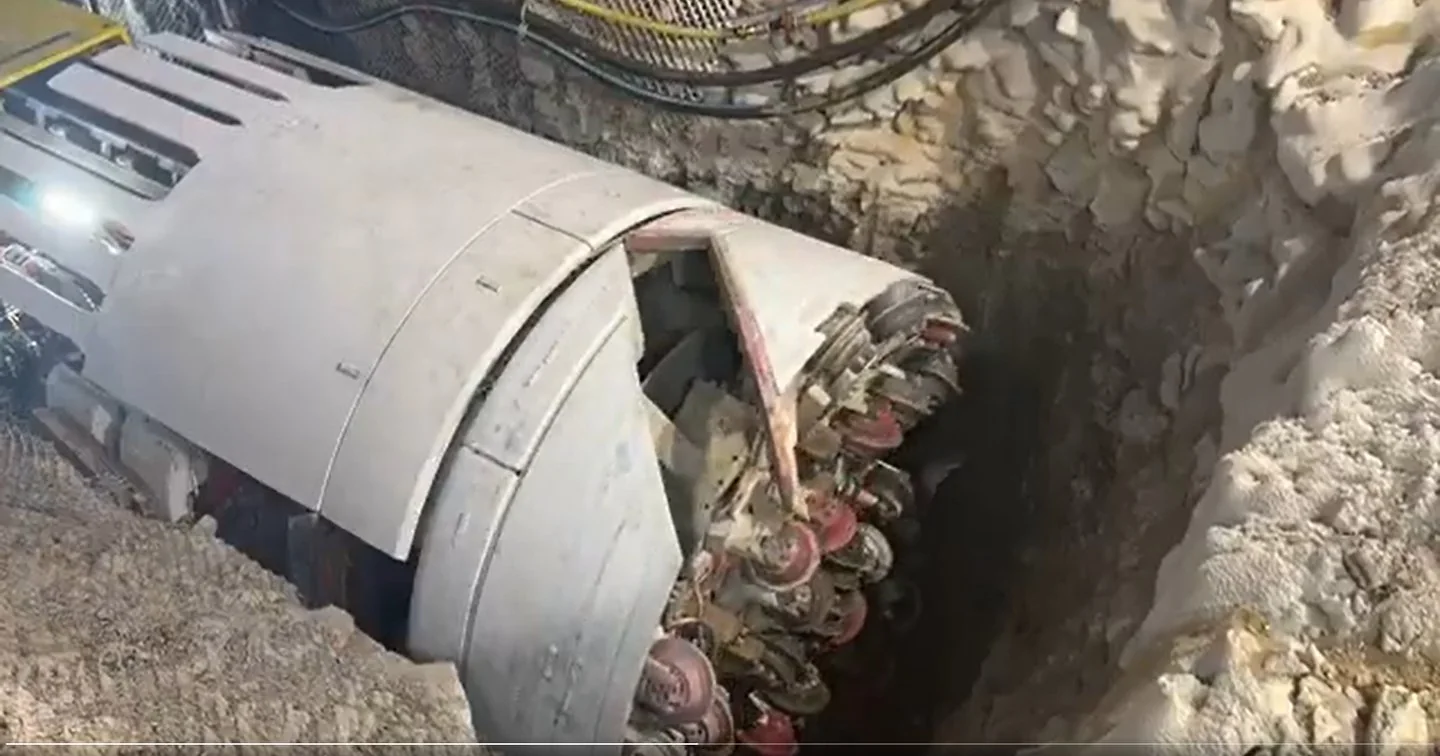
Newly reported construction records provide one of the clearest numerical benchmarks yet for The Boring Company's work beneath downtown Nashville: one Music City Loop tunnel boring machine advanced a reported 3,680 feet by October 31.
The figure comes from a November 17 report by The Tennessean. According to figures quoted from that report, the machine had traveled 170 feet by April 15 and advanced another 3,510 feet through October 31. That is nearly seven-tenths of a mile of excavation by one machine, not seven-tenths of a mile of a fully operational transportation system.
The publication's underlying records and full route map were not independently available to LOOP Nashville for review. Accordingly, the distance is attributed to The Tennessean, and the figure should not be treated as a verified combined total for both of Nashville's active machines.
What the excavation number measures
The Boring Company began tunneling after Tennessee approved the project’s use of state right-of-way in February. It subsequently reported two machines, Prufrock-MB1 and Prufrock-MB2, excavating simultaneously from the Lot 16 construction site near the State Capitol.
The company's published route follows Rosa L. Parks Boulevard, Eighth Avenue South, Lafayette Street, and Murfreesboro Pike toward Nashville International Airport. The airport connection is designed around parallel, one-way tunnels. Progress by one machine therefore cannot be equated with completion of the corresponding distance in both directions.
Public discussion of The Tennessean's map places the two machines at different points along the Eighth Avenue corridor. Because LOOP Nashville could not inspect that map directly, we are not assigning exact current intersections or coordinates to either machine.
What does the rate of progress tell us?
The reported additional 3,510 feet between April 15 and October 31 represents an average of approximately 17.6 feet per calendar day, counting all days in that period. It is a useful historical average, but it is not the machine's cutting rate when actively excavating.
Machine commissioning, servicing, equipment modifications, site work, and other downtime can all affect elapsed-time averages. Just as importantly, the performance of the first machine cannot automatically be projected across every future segment of the route.
In its October project update, The Boring Company said it had incorporated more than 300 improvements developed through MB1 into subsequent equipment. The company also announced preparations for MB3 and construction of MB4, with a goal of having four machines underground by year-end. Those are company targets, not independently confirmed November milestones.
Parallel tunneling could increase total excavation across the network without making any individual machine travel faster. For that reason, multiplying the historical daily average by the remaining airport distance would be a misleading way to predict the opening date.
Nashville's hard limestone is part of the story
The Boring Company has adapted its equipment to tunnel through Nashville's hard limestone, a different environment from the softer material encountered on earlier projects in Las Vegas. A November 17 interview published by Andreessen Horowitz describes the company's hard-rock machine design and quotes company leadership discussing both early learning and expectations for faster production.
Limestone can provide strong surrounding rock, but Nashville's karst geology, groundwater conditions, and changes between rock formations also warrant engineering attention. A separate October report from WPLN examined geological concerns raised by a Southern Environmental Law Center-commissioned study. Neither the reported excavation distance nor the existence of those concerns alone establishes how the remaining route will perform.
Does this change the projected opening date?
The original state announcement anticipated that an initial segment could open by the end of 2026. In the November 17 interview, The Boring Company's leadership instead described a goal of carrying passengers over an initial downtown mile in the first quarter of 2027, while work continues toward the airport. That is a company expectation, not a confirmed service date.
Even once a stretch is excavated, passenger service still depends on completed stations and access points, required safety systems, communications, vehicle operations, testing, and regulatory compliance. Likewise, an initial downtown opening would not mean the entire downtown-to-airport corridor is ready.
A benchmark, not a finish line
This is an important change from the information publicly available earlier in the year. When LOOP Nashville examined construction progress in a previous report, the distance traveled by either machine had not been publicly established. The newly reported figure now provides a specific number that can be compared with future disclosures.
The most useful next measurements would be separate excavation totals for MB1 and MB2, confirmation of MB3's launch status, and an accounting of which completed sections are ready for station connections and passenger systems.
The Boring Company is building beneath downtown Nashville. The more important remaining question is how quickly additional excavation, construction, and testing will turn that work into a transportation service.