
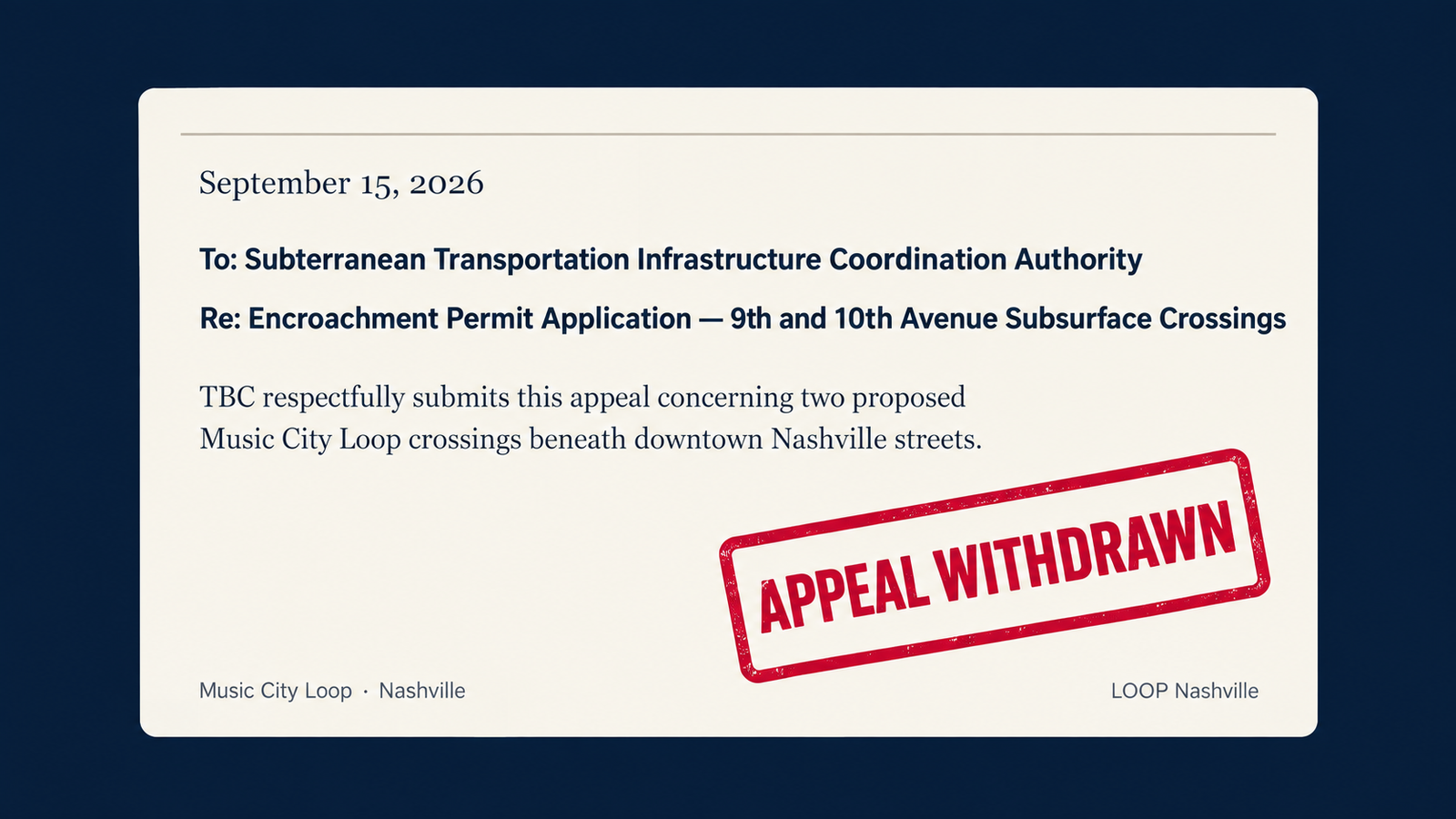
The Boring Company has withdrawn an appeal involving two proposed downtown Music City Loop tunnel crossings, ending what could have become an early test of Tennessee’s new process for resolving disputes over subterranean transportation projects.
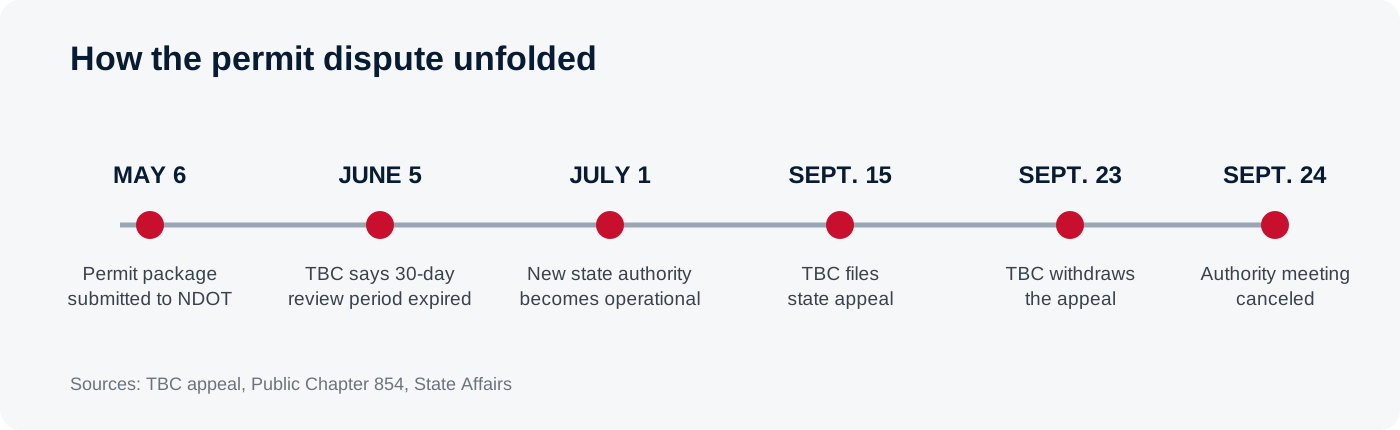
According to State Affairs, TBC project development official Isaac Aronson notified members of the Subterranean Transportation Infrastructure Coordination Authority Wednesday evening that the company was “respectfully” withdrawing the appeal it filed Sept. 15.
The authority had been scheduled to consider the matter Thursday. The meeting was canceled after the withdrawal. State Affairs reported that neither TBC nor Nashville Mayor Freddie O’Connell’s office immediately provided an explanation for the change.
The appeal itself was narrow. It concerned roughly 50 feet of tunnel beneath 9th Avenue North and another short crossing beneath 10th Avenue North near Nashville Yards.
The permitting question behind those crossings was much larger.
The dispute began with a May permit application
TBC submitted an encroachment permit package to the Nashville Department of Transportation on May 6 seeking approval for two subsurface crossings associated with the Music City Loop.
The company said each crossing would extend approximately 50 linear feet at a depth of about 50 feet below grade. Its permit package said the work would require no open-cut excavation, trenching, permanent surface structures or surface traffic disruption within Metro right of way.
The package also included a legal opinion arguing that the crossings could be handled administratively by NDOT rather than requiring a Metro Council vote. TBC’s cover letter described the filing as including a legal analysis “justifying this as an administrative permit not subject to a Metro Councilmember vote.”
That distinction was important. The proposed tunnels would pass underneath Metro-owned streets, but TBC’s position was that the work amounted to subsurface excavation rather than the type of permanent encroachment requiring legislative approval.
According to TBC, NDOT never acted on the application.
TBC turned to Tennessee’s new tunnel authority
By September, the company invoked the Subterranean Transportation Infrastructure Coordination Act, enacted earlier this year as Public Chapter 854.
The law created a state authority to resolve disputes and hear appeals involving qualifying underground transportation projects. LOOP Nashville previously examined the law and the authority’s role in detail.
In its Sept. 15 appeal, TBC said its permit application had been submitted May 6 and that the applicable review period expired June 5. Because NDOT had not acted, the company argued that the application was deemed denied and therefore eligible for appeal.
TBC asked the authority to review the case and approve the permit application. It also said it was prepared to address any technical, safety, utility or engineering issues raised during the authority’s review.
Had the appeal proceeded, the case could have provided an early interpretation of how the new state process works when a local government does not act on a Loop permit. Instead, TBC withdrew it before the authority could rule.
One timing question never reached a decision
One aspect of the appeal would likely have required the authority to address a threshold issue before reaching the engineering merits.
TBC calculated the 30-day review period from the May 6 application and said it expired June 5. Public Chapter 854, however, has separate effective dates for preparatory provisions and the law’s broader substantive framework, with the authority becoming operational July 1.
That could have raised a question over how the new law’s local-review deadlines apply to an application already pending before the substantive appeals framework took effect.
TBC’s filing plainly took the position that the deadline ran from May 6. Because the appeal was withdrawn, the authority never had to decide whether that interpretation was correct.
Why did TBC withdraw?
The public record does not provide an answer, so the reasons for the withdrawal remain uncertain.
TBC has not publicly said that its legal position changed, and the available records do not show that it withdrew the underlying May 6 permit applications. The company withdrew the appeal.
The permit issue may be moving toward resolution
One possibility is that the state appeal became unnecessary. TBC’s original position was that NDOT already had authority to approve the crossings administratively. If Metro and TBC are now working toward an administrative resolution, there would be little reason to ask a state board to decide the dispute.
There is no public documentation confirming that such an agreement has been reached. The timing of the withdrawal, however, leaves open the possibility that the underlying issue is being addressed through another process.
TBC may have preferred a cleaner case under the new law
The timing of the May application presents another possibility. A future application filed and reviewed entirely under the new statutory framework would not raise the same question about how the new deadlines apply to a permit that was already pending.
That does not establish that TBC believed its September argument was incorrect. It does mean this appeal carried a procedural issue separate from the underlying question of whether the crossings should be approved.
There may have been little reason to create precedent over two short crossings
The physical scope of the dispute was small compared with the larger Music City Loop. TBC was seeking approval for two crossings of roughly 50 feet each, both approximately 50 feet below grade and designed to avoid open-cut street excavation.
A ruling from the new authority, however, could have implications for future disputes involving much larger portions of the system. The Boring Company holds a state lease and grading authorization covering approximately 25 miles of parallel tunnels, and the company says more than 40 potential stations are in various stages of planning or design.
If the two street crossings can ultimately be approved without a state-level dispute, TBC may have had little incentive to seek an early precedent from the authority.
The original issue was local approval, not state intervention
When TBC submitted the permit applications in May, its position was not that Tennessee needed to override Metro Nashville. Its position was that Metro could approve the crossings itself.
The permit package included a legal opinion contending that NDOT could administratively approve subsurface crossings beneath Metro rights of way because the tunnels would not create permanent surface structures or interfere with normal street use.
That leaves open a path for this particular dispute to end without a broader state-versus-local permitting fight. Whether that is what is happening now is not yet publicly known.
What happens next
For now, the appeal ends without a ruling on the merits. The authority did not determine that Metro improperly failed to act. It did not approve the crossings. It did not reject TBC’s argument that NDOT could approve them administratively. And it did not resolve the timing question raised by the May application and the July launch of the new authority.
Unless additional records emerge, all that can be said definitively is that TBC invoked the new state appeals process and then withdrew its challenge before a hearing.
The underlying crossings remain significant for another reason. The engineering package attached to the permit application contains detailed drawings showing multiple Music City Loop tunnels connecting directly into Nashville Yards parking structures on both sides of 9th and 10th avenues.
Those plans provide one of the clearest public looks yet at how a downtown Music City Loop station could actually function. LOOP Nashville examined the drawings in a companion deep dive into the newly revealed Nashville Yards station design.
SOURCES
- Musk’s Boring Co. withdraws appeal over downtown Music City Loop crossings · State Affairs
- TBC Appeal — 9th and 10th Avenue Subsurface Crossings, Sept. 15, 2026 · TBC-TN LLC
- Music City Loop 9th Ave and 10th Ave Crossings Permit Package · The Boring Company
- HB 2450 / Public Chapter 854 · Tennessee General Assembly
- Public Chapter 854 · Tennessee Secretary of State
- Music City Loop · The Boring Company