
As reported by State Affairs, Tennessee is moving forward with a major redevelopment of state-owned property around the State Capitol after the State Building Commission unanimously approved a revised procurement plan Monday.
The vote clears the Department of General Services to seek a private development partner for five downtown parking areas: Lot 16, Lot 28, Lot 29, the Blue Lot and the Gold Lot. Together, the properties cover approximately 10.37 acres.
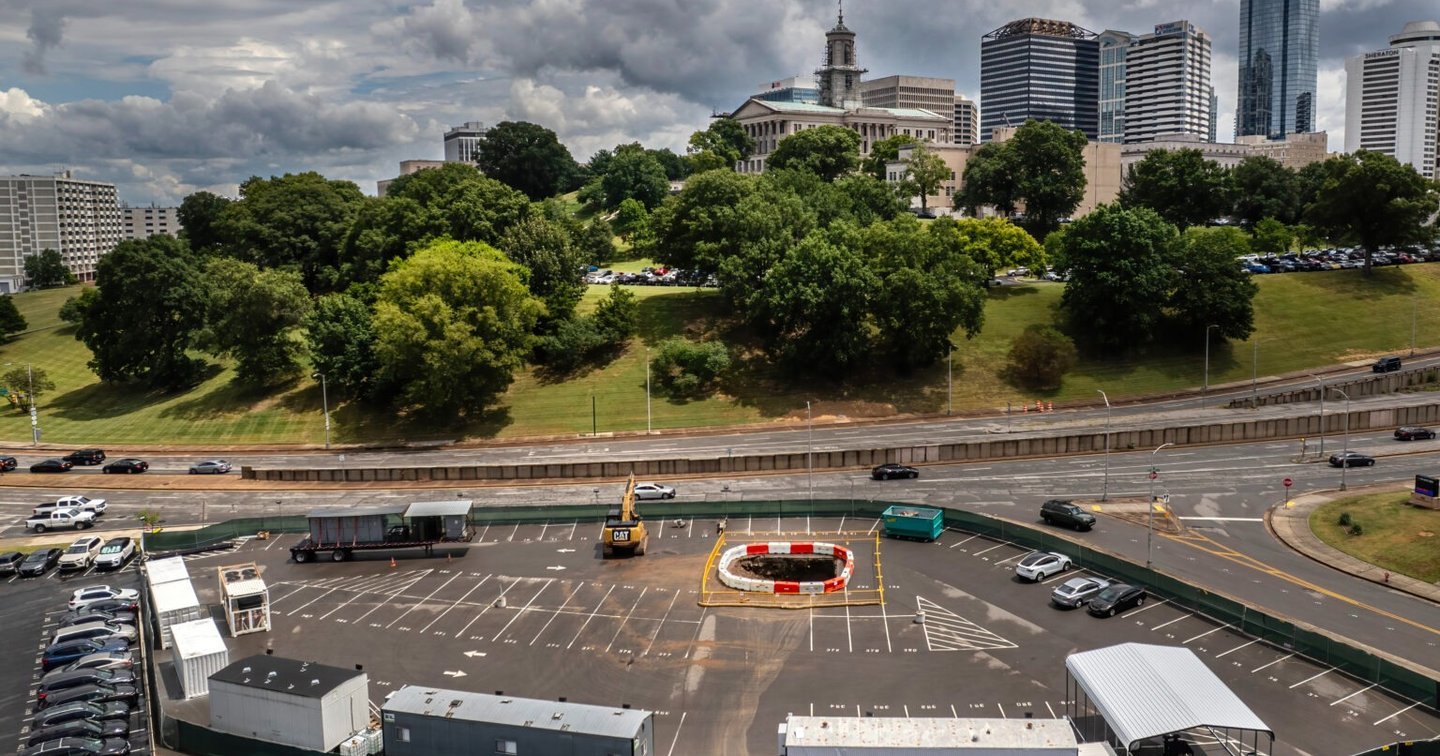
For Music City Loop watchers, one parcel makes the redevelopment especially notable. Lot 16 is not simply another state parking lot. It is the launch site where The Boring Company began building the Loop’s airport alignment and where two tunnel boring machines are now working underground.
Five parking lots, 10.37 acres and a new mixed-use district
The State Building Commission’s official agenda describes the project as a public-private partnership that could transform the five surface parking areas into a mixed-use district with housing, hotels, retail and public space. The private partner would be responsible for designing, building, financing and maintaining the development.
The state is also requiring the project to replace the existing parking on the five sites on a one-for-one basis. State Affairs reported that the revised procurement further specifies that at least 15 percent of the parking must remain available to state employees around the clock, while the remainder could require payment outside normal working hours.
Under the structure described by State Affairs, Tennessee would retain ownership of the land and lease it to the private developer. The developed property would return to Metro Nashville’s property-tax rolls, and the state would ultimately take ownership of the improvements when the ground leases expire.
The state may also give the selected developer an option to expand the project to the nearby James K. Polk Building site if Tennessee eventually vacates that property. That option would require additional approvals and is not part of the initial 10.37-acre development footprint.
The proposal changed after an earlier deadlock
The same procurement did not move forward on Sept. 10. The six-member State Building Commission split 3-3 after several members raised questions about parking, financial terms and the process for selecting a developer. The commission instead agreed to reconvene after General Services revised the proposal.
The most visible change was the order of the state’s evaluation priorities. State Affairs reported that financial return to Tennessee is now the top priority, followed by state employee parking. Economic development ranks third, followed by urban integration, design excellence and placemaking, and then workforce housing.
The revised process also adds another layer of competition at the end of the selection process. At least two finalists are expected to advance to a best-and-final-offer stage, rather than allowing the state to potentially enter final negotiations with only one development team.
The accelerated process continues to have critics, including Sen. Heidi Campbell, a Nashville Democrat who has repeatedly opposed the Music City Loop. That position contrasts with her broader record of supporting expanded public transit in Nashville.
During her 2023 mayoral campaign, Campbell said Nashville needed to “aggressively get the ball rolling” on transit and multimodal connectivity, and earlier this year she co-sponsored legislation approving three major corridor projects included in the city’s Choose How You Move transportation program. Campbell has nevertheless opposed the Loop specifically, co-sponsoring a separate resolution against the project and casting the only vote for it when the measure failed 1-7 in the Senate Transportation and Safety Committee.
In the Capitol redevelopment debate, State Affairs and WKRN reported that Campbell questioned the waiver of the state’s normal disclosure timeline and the use of a qualifications-based process for land that state appraisals value at more than $160 million. State officials have argued that moving more quickly can reduce the impact of rising construction costs and begin producing revenue from property now used primarily for surface parking.
Lot 16 is where the redevelopment and the Loop meet
The Boring Company identifies Lot 16, near the Capitol, as the beginning of the Music City Loop’s airport alignment. It is also the project’s first tunnel boring machine launch site. The company’s current project materials say the site supports two TBMs, both of which are now on site and tunneling.

The company’s August construction update said its second machine, Prufrock-MB2, launched from Lot 16 after commissioning and joined Prufrock-MB1 in active tunneling. The site also contains offices, an Operations Control Center and other infrastructure needed to support tunnel construction.
Monday’s redevelopment vote does not itself approve a passenger station at Lot 16. The Boring Company says more than 40 Music City Loop stations are in various stages of design, but a permanent Capitol-area passenger station at this site has not been announced as an approved station.
State Affairs reported that Senate Speaker Randy McNally said after the meeting that the redevelopment and the Boring Company’s work could coexist. He indicated tunneling could continue through the site and that a future station could be considered separately, with additional State Building Commission approval.
Two projects, one increasingly important piece of land
For now, the state is advancing two distinct projects on the same property. Underground, The Boring Company is constructing the first tunnels of a transportation network that begins at Lot 16. Above ground, Tennessee is beginning a process that could replace the surrounding surface parking with a dense mixed-use development.
If a passenger station is eventually approved at or near Lot 16, the redevelopment could place housing, hotel rooms, retail, offices or public space immediately alongside a downtown Loop access point. If no station is ultimately built there, Lot 16 would still remain significant as the construction origin of the airport alignment.
That makes the redevelopment worth watching closely as both plans advance. The surface development is still a procurement, not a final construction agreement, and the official State Building Commission agenda says General Services must return for approval of subsequent agreements.
What happens next
According to State Affairs, the request for qualifications was scheduled to be issued Tuesday, Sept. 22, with responses due Nov. 23. The state expects to identify a negotiating partner by February 2027 and return to the State Building Commission for another approval by March 11.
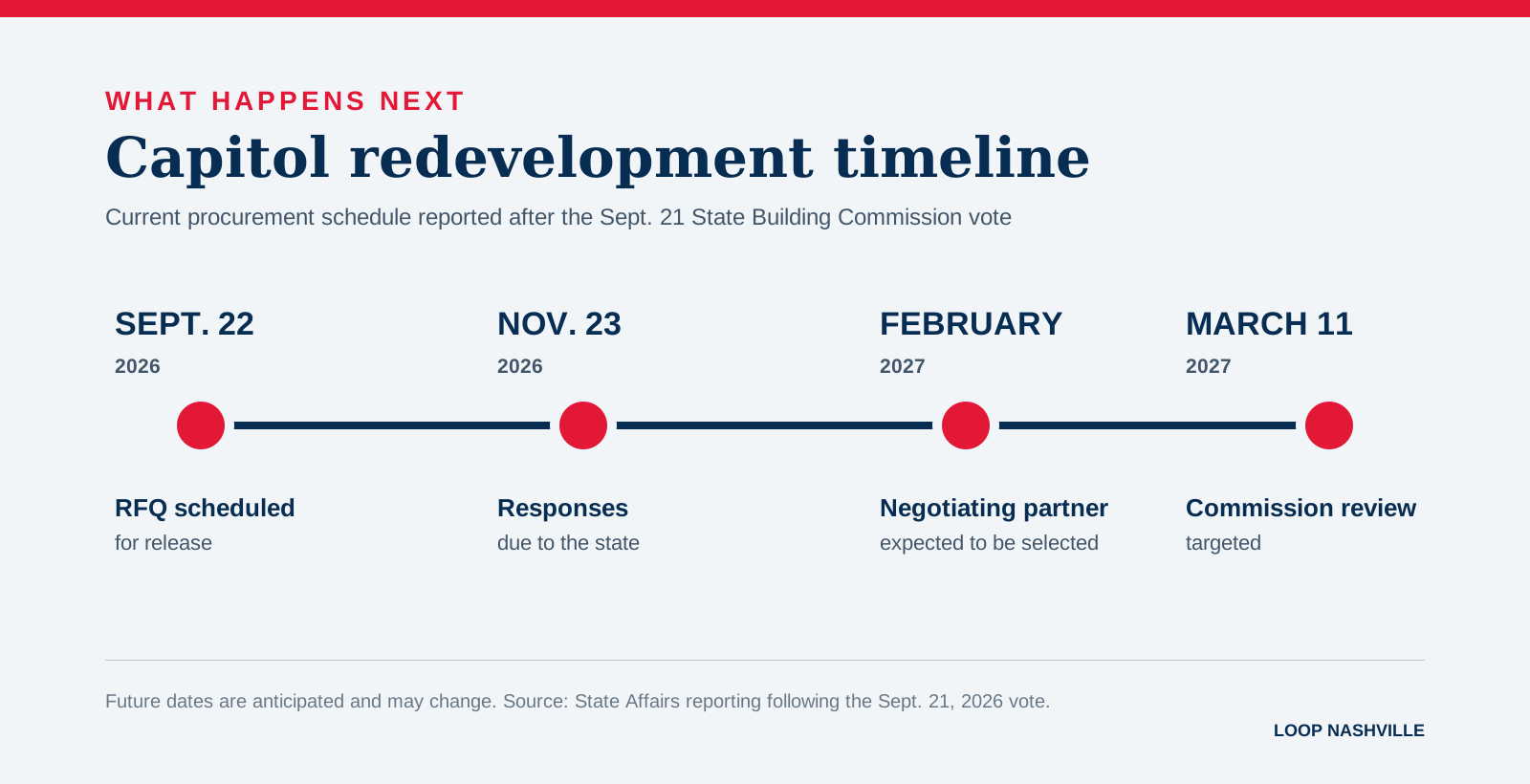
Those steps mean Monday’s unanimous vote is the beginning of the competitive development process, not the end of it. The identity of the developer, the final design, financial terms, construction schedule and any permanent relationship with Music City Loop infrastructure all remain subject to future decisions.
SOURCES
- Capitol development proposal OK’d following new emphasis on competition, parking · State Affairs
- State Building Commission Specially Called Meeting Agenda — September 21, 2026 · State of Tennessee
- Music City Loop · The Boring Company
- Music City Loop Blog — August 1, 2026 · The Boring Company
- Tennessee fast-tracks development of $160M in downtown Nashville land · WKRN
- 2023 Mayoral Candidate: Heidi Campbell — Transportation Vision · Connect Mid-TN
- SJR 657 — Choose How You Move corridor project approvals · Tennessee General Assembly
- SJR 684 — Resolution opposing the Music City Loop · Tennessee General Assembly